Adjustable Knee Support
The Mueller Adjustable Knee Support uses a neoprene blend and features a 4 way external adjustment system for better compression. Replaces the MU4531 Adjustable Knee Support

Knee joint instability refers to the medical condition under which the tissues of the knee (muscles, ligaments or bones) weaken to the point at which the bones are not held in their proper place. Below you’ll find our knee brace for instability range. Not sure what’s causing the pain? Read why does my knee hurt.

The Mueller Adjustable Knee Support uses a neoprene blend and features a 4 way external adjustment system for better compression. Replaces the MU4531 Adjustable Knee Support

The McDavid BioLogix Knee Brace combines a semi rigid lightweight design and bi-lateral aluminium dual axis geared hinges to provide a fluid feel and a natural range of motion.

Optimal support for knee instability with SlimLok ROM hinge. The BioSkin CrossFire ROM protects the MCL, ACL and other knee ligaments, providing extra stability while limiting unwanted twisting and bending of the knee joint. The hinge is very thin, only ½ inch, while providing flexion and extension lockouts needed for rehabilitation. The BioSkin material is very comfortable with a highly-compressive single-layer portion surrounding the knee. The Cirrus™ material is sewn in a pre-tensioned manner to prevent bunching behind the knee which ensures a comfortable fit throughout vigorous activity. The brace’s comfort continues into the small details of how it is sewn together; featuring the ActiveSeam™ stitch that prevents unwanted chafing in the more sensitive areas of the knee.

The Sure-Wrap Elastic Bandage with Clips is the ideal accessory for providing compression to heal strains, sprains and other soft tissue injuries.

The Mueller Elastic Knee Stabilizer is a lightweight knee brace with springs. Steel springs support both sides of the knee, and the open patella helps relieve pressure on the kneecap.

The Mueller Elastic Knee Support combines robust knee support with unrestricted range of motion while featuring a contoured design that prevents bunching in the popliteal area behind the knee.

The McDavid Elite Engineered Elastic Dual Wrap Knee Brace w/ Support Stays offers high grade engineered elastics, bilateral stabilizing side stays andother features to provide your patients with outstanding support and comfort for their injured or unstable knees.

Knee ligament protection. The BioSkin Gladiator uses a rigid hinge to effectively protect knee ligaments, including after reconstruction. The rigid strapping system firmly anchors the Gladiator to the leg, avoiding the need for longer, less comfortable braces. Pins in the hinges may easily be set to limit flexion and/or extension.

Knee Ligament Protection. The BioSkin Gladiator Front Closure uses a rigid hinge to effectively protect knee ligaments, including after reconstruction. The rigid strapping system firmly anchors the Gladiator to the leg, avoiding the need for longer, less comfortable braces. Pins in the hinges may easily be set to limit flexion and/or extension.

The Mueller Green Adjustable Knee Brace is an adjustable hinged knee brace for weak, injured and arthritic knees. Self-adjusting criss-cross straps above and below the kneecap give medial-lateral support, and the wraparound design makes it easy to put on.

The Mueller Hg80 hinged knee brace gives maximum medial-lateral support for weak or injured knees, with triaxial hinges, a tibial containment system, patella buttress and Mueller-exclusive HydraCinn fabric.

The Mueller Hg80 Knee Brace is a knee brace with patella buttress and a tibial containment system with a secondary shell. Steel springs support both sides of the knee, and upper and lower straps give a custom fit.

The Mueller Hg80 Knee Support is a lightweight knee brace that keeps the knee flexible and mobile. Tendon-like support springs and multi-directional compression add support without bulk, and a permanently bonded antimicrobial barrier helps control odour.
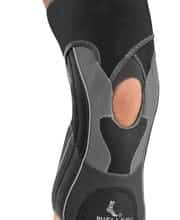
Wear the Mueller Hg80 Premium Knee Brace and enjoy all day support during your favourite activities – sport, recreational or otherwise.

The Mueller Hg80 Premium Knee Stabilizer has lightweight and neoprene-free breathable fabric with maximum medial-lateral support to help protect weak or injured knees.
This product has replaced the Hg80 Knee Stabilizer

The LP Hinged Knee Stabilizer has metal hinges that support the medial and lateral ligaments and an EVA ring that helps prevent patellar displacement. Closed-cell neoprene keeps the knee warm during activity and recovery.

The Mueller Hinged WrapAround Knee Brace features a triaxial hinge to track your knee’s natural movement. The fitted sleeve slips on and provides maximum medial-lateral support of your weak or injured knee. Fits either knee.

The McDavid knee brace with dual disk hinges gives Level 3 maximum protection: independently articulated sidearms with cushioned hyperextension stops, plus an open 360° padded buttress that isolates and supports the patella.
In most cases, this instability results from a knee ligament injury as these ligaments are normally responsible for holding the joint together.
Individuals suffering from knee instability will feel as though the knee is unable to support their full body weight and is "giving way" beneath them. Knee joint instability is usually treatable at home using rest, icing, compression and elevation of the knee. If the instability is serious (probably due to a ruptured or detached ligament) surgery may be necessary to correct the problem.
Match the support to the cause:
Knee joint instability due to ligament damage can be a result of either injury or overuse. In other (less common) cases it can be a result of a congenital condition known as being "double jointed". Double jointed individuals are born with knee joints that are looser than normal.
Other potential causes of knee joint instability include primary injuries that then cause instability as a secondary condition. These primary conditions can include injuries such as knee osteoarthritis and patellar instability, among others.
Individuals whose jobs or other activities require extensive use of their knee are more liable to suffer from instability. These include athletes, especially those in sports requiring plenty of running, jumping and sharp changes in speed or direction while running. Sports like football, soccer and rugby fall into this category. Other activities that make strenuous demands of the knees include gymnastics, dancing and even skiing.
As we have mentioned earlier, those with knee joint instability will have difficulty supporting the normal body weight on an unstable knee. There will be a feeling that the knee is "giving way" beneath them.
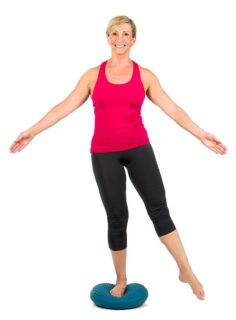
One way to test for instability at home is to try to stand on one leg (the one with the suspect knee). If the knee cannot support the weight in this position, knee joint instability may be a factor. The next step should be to schedule an appointment with a doctor for an examination and diagnosis.
To confirm a suspected case of instability, doctors will perform various physical tests. The goal will usually be to check the movement of the knee and to listen for unusual sounds while doing so. As mentioned earlier, some cases of knee instability are due to other primary causes. If this is the case, the aim would be to treat those primary causes so that, once they have been corrected, the knee joint instability should resolve itself.
Other steps that doctors may take during the examination & diagnosis stage include:
As we have mentioned above, some cases of instability have another, underlying condition such as knee osteoarthritis as the primary underlying cause. In these cases, the focus will be on treating the primary cause rather than the instability.
If the knee joint instability does not have another injury as its cause, most doctors will, as a first step, attempt to treat it at home using conservative (non surgical) methods. These will usually include some or all of the following:
Once the ligaments are well on the way to healing, the patient should start to work with a physiotherapist on rehabilitative exercises that will strengthen the knee muscles and ligaments. This will help to reduce the risk of recurrence of the knee joint instability.
If the knee joint instability is a result of severe ligament damage such as rupturing, the conservative treatment approach may not be enough. A surgeon can perform arthroscopic knee surgery to repair the ligament and, if necessary, reattach it to the adjacent bone.
To do this, the surgeon may either take a portion of healthy ligament tissue from another part of the knee. Alternatively, (s)he may use ligament tissue donated by another individual.
Once surgery is complete and healing is underway, rehabilitative exercises may be required to ensure the knee returns to full health with less or no risk of recurrence of instability.