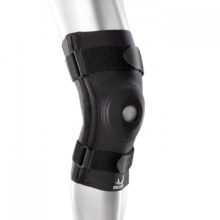
However, knee braces are not all the same: they come in a vast number of styles, types and sizes. To make the best choice for a patient, consider the type of brace, the closure, whether the kneecap should be open or closed, and the size, as outlined below.
Choosing a Knee Brace for Your Patient
Once a patient has been fitted, they will have their own questions, such as how long to wear the brace, how to put it on and how to care for it. Our post Knee Supports: 6 Questions and Answers covers those, so this page focuses on choosing the right brace.
Which Type of Knee Brace?
There are basically six types of knee brace that can be purchased "off the shelf"- hinged braces, knee stabilizers, knee sleeves, knee straps, patella stabilizers and offloading knee braces. As an alternative to getting a knee brace "off the shelf", you can also have one custom made.
Hinged Knee Braces
Hinged knee braces will offer the maximum lateral knee support (protection from tearing or overstretching of ligaments on either the inside or outside of the knee). They will also allow the patient to maintain the most natural knee movement possible. Hinged braces are most useful for severe knee instability problems such as those caused by torn knee ligaments or meniscus tear injuries. These types of injuries are unfortunately relatively common in contact sports or in sports requiring sharp changes in direction or speed of running.
Please read our post on hinged knee brace questions and answers if you need more information on this type of brace.
Knee Stabilizers
A knee stabilizer will be an appropriate choice to treat mild to moderate knee sprains (when the ligament has been overstretched and not torn). These braces don't have hinges but are instead equipped with metal or plastic stays or metal springs along the sides to provide some lateral knee stability (although not as much as you would get from a hinged knee brace).
If you don't have a severe knee instability problem but would just like to walk, run or play sports with increased confidence in your knee, you may find that a simple knee stabilizer is best suited for your needs.
Knee Sleeves
Knee sleeves come without either hinges or metal/plastic stays or springs, so they do not provide any lateral knee support. They are an appropriate choice if you are looking for warmth and compression for a mild knee injury or general knee soreness. Many athletes also wear them for comfort and confidence while walking, running or playing sports.
Knee Straps
Knee straps are used to apply pressure to specific areas of the knee joint. For example, if you are suffering from patellar tendinitis, you can use a knee strap to apply pressure to the patellar tendon situated just below your patella or knee cap. Alternatively you can wear a knee strap above your knee to apply pressure to your iliotibial band and reduce the friction as it moves across the bony protrusion on your outer knee.
Patella Stabilizers
Patella stabilizers (also called patella braces) are designed to help prevent patella instability problems like subluxation and/or tilting. The main feature of these braces is usually a buttress around the knee cap that helps keep it properly seated in the knee's trochlear groove. These braces can sometimes include other features as well, such as metal stays or springs to provide lateral joint stability.
Unloader Knee Braces
Unloader knee braces are useful in treating cases of knee osteoarthritis when the cartilage on one side of the knee (usually the inner side) has worn down, causing pain when walking or placing weight on the knee. An unloader brace is designed to shift the point of contact between these two bones from an area of cartilage deterioration to one with healthier cartilage, reducing pain in the process.
Some patients find that an unloader brace helps them put off knee replacement surgery, although the evidence on this is limited.
Please read our post on unloading knee braces if you would like more detailed information on this type of brace.
Custom Made Knee Braces
As an alternative to an off the shelf brace, custom knee braces are also available, albeit at a significantly higher cost. Although these braces are not among those available on this site, they may be the appropriate choice if the medical professional treating the patient feels that his or her knee injury is untypical of those for which off the shelf braces are intended.
Slip-On or Wraparound Closure?
There are essentially two closure styles available - slip on and wraparound. The former is put on (as the name implies) by inserting your foot through the opening of the brace and pulling it up over your leg. This type of brace is normally sized since the fit must be precisely determined in order to get the best support.
Wraparound braces, on the other hand, can be placed either in front of or behind the knee. You then adjust this brace using its Velcro straps. This type of knee splint is well suited for individuals with compromised manual dexterity or strength. Individuals with certain neurological conditions are examples.
Wraparound (also called front closure) knee braces are also a good choice for individuals with unusual knee or leg shapes. They normally use Velcro enclosures that provide the versatility needed to adapt to such shapes.
Open or Closed Patella?
A closed patella brace will give your kneecap the same support as provided to the rest of your knee.
Open patella knee braces relieve the pressure on the knee cap and are generally more comfortable. They include knee splints with buttresses that provide maximum support for the patella to assist with patella tracking problems. The greater comfort level of these braces can be a great help with patient compliance (making it easier for the patient to wear the brace as much as he/she needs to for it to be effective).
Getting the Right Size
Sizes can be measured in various ways but the correct size is essential if the brace is to function as intended. If the brace is too large, it may not provide the degree of compression and/or support the patient needs. On the other hand, if it is too tight and uncomfortable, the patient may not be able to wear it for extended periods. This would then compromise its therapeutic effectiveness.
Always check the manufacturer's sizing chart, which usually says which size to choose if the patient is between sizes.
Please bear these questions in mind as you browse our selection of knee splints below. For more information, please consult our posts on choosing a knee brace for basketball, choosing a knee brace for running or on running injuries and choosing the right knee brace. Other useful information may be found in our post on choosing a knee brace for a meniscus tear.