
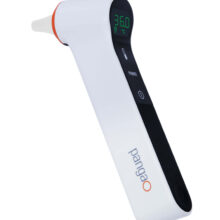
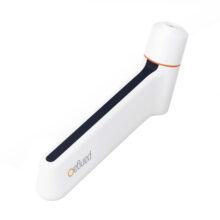


InfraRed Thermometer PG-IRT1603
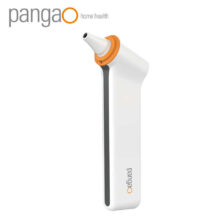
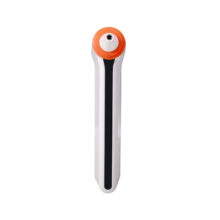
Our InfraRed Thermometer PG-IRT1603 is packed with attractive features that will help you keep your office safe. Works in both forehead and ear temperature measurement modes and licensed by Health Canada. Medical Device License Number 104050.
Our InfraRed Thermometer PG-IRT1603 is packed with attractive features that will help you keep your clinic or work setting safe for customers and employees. It is usable for either forehead or ear temperature measurement. In addition, you can use it for temperature measurements via other parts of the body.
The PG-IRT1603 is useful for contactless temperature measurement of visitors to confirm whether they may be carrying an infection that could be harmful to others. The measuring range of the thermometer is 34.0ºC to 42.2°C and you can use it to measure the temperatures of both adults and children. The InfraRed Thermometer PG-IRT1603 takes its place alongside other PPE products such as Cleaners and Disinfectants as vital components of the arsenal of tools needed to combat COVID-19.
Other useful features of the InfraRed Thermometer PG-IRT1603 include::
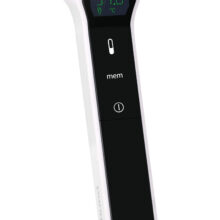
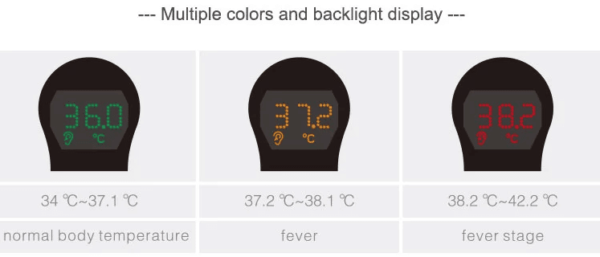
- Fever alarm with three back light colors (green, orange and red) and sounds;
- Voice indication after temperature measurement;
- Memory storage of the last 9 temperature measurements;
- Automatic turn off to conserve battery life after 30 seconds of non use.
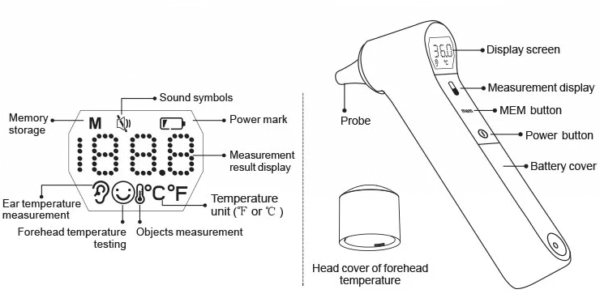
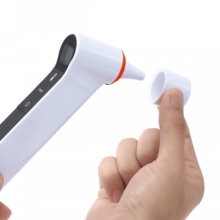
The InfraRed Thermometer PG-IRT1603 can take readings in 1 second and is accurate to within 0.1°C of the true temperature. It is also switchable between Celsius and Fahrenheit readings. A unique battery cover design allows you to change batteries quickly and easily.
For power, the PG-IRT1603 uses dual 1.5V AAA batteries.
With this infrared thermometer you can take contactless temperature measurements via the forehead.
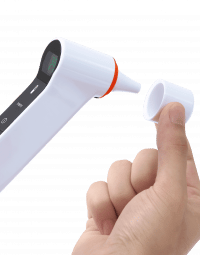
For more accurate (though not contactless) measurements, you can alternatively measure temperature via the ear.
In addition, this versatile thermometer allows you to measure the temperatures of other objects.
This thermometer carries a Health Canada Class 2 MDALL license.
In Which Situations Are Infrared Thermometers Most Useful?
The popularity of these thermometers has increased significantly in the past year due to the arrival of the coronavirus pandemic. The pandemic has increased the need to screen large numbers of people before entry to a facility in which they will be in close contact with other occupants of that facility. Their usefulness in this context is of course dependent on how easy it is to use them to take accurate temperature measurements.
However, there is no doubt that, for reading temperatures with minimal personal contact, infrared thermometers are the best option available today.
Infrared thermometers are also a popular choice among pediatricians trying to take the temperatures of young children. Young children have a tendency to “fidget” under these circumstances. These thermometers therefore offer a way for doctors to take temperature measurements that are at least reasonably accurate without too much risk to either doctor or patient.
How Accurate Are Infrared Thermometers?
According to recent research into this subject, infrared thermometers are almost as accurate in measuring temperature as other types of thermometer when used correctly. In general, you will get more accurate temperature measurements via the ear than the forehead, since the latter is a more accurate measurement of core body temperature.
We provide some guidance below on how to use your infrared thermometer correctly in order to obtain the most accurate results possible, even when measuring temperature via the forehead.
To be clear, however, in most circumstances, an infrared thermometer, while offering a high degree of accuracy, will not be as accurate as either a digital or mercury based thermometer used for internal temperature measurement (e.g. rectal or ear measurement). The advantage of infrared thermometers lies in their capability for contactless (and therefore safer) temperature measurement.
Infrared thermometers are also significantly quicker in temperature measurement than either digital or mercury based thermometers.
In addition, if the infrared thermometer is being used to detect the possible presence of Covid-19, it can only do so by detecting a fever. If the individual has taken a fever reducing medication, the thermometer will not be able to detect the presence of viral infection. It will also be similarly ineffective if the subject is an asymptomatic carrier of the virus.
How Can I Ensure That I Get The Most Accurate Temperature Reading Possible?
To ensure that you get the most accurate reading possible from your infrared thermometer, we suggest the following precautions:
- Read the instruction manual carefully before the first use of the thermometer;
- In reading the manual, please make particular note of its distance to spot ratio. This is the surface area that it can accurately read compared to your distance from that area. Generally speaking, the closer you are to the subject, the smaller the measurable surface area and the more accurate the reading;
- Ensure that the thermometer is clean and free of elements like frost, moisture, smoke and other foreign matter. Remember that the thermometer reads temperatures by focusing the infra red radiation emitted by the subject it is measuring onto an internal thermopile. To do this properly, the thermometer (and its lens in particular) has to be free of dirt, moisture, etc. For instructions on cleaning your thermometer, please see below;
- Choose the mode of temperature measurement (i.e. forehead, ear or other body part). We provide comments and suggestions on this step below.
For more on this subject, please review our post on how to get accurate temperature measurements from infrared thermometers.
How To Clean Your Infrared Thermometer
As we have emphasized above, cleaning your thermometer before use is essential to obtaining the most accurate temperature reading possible. To clean your thermometer:
- For a light clean, soak a cloth or cotton swab in water;
- Wipe the lens and then the main body of the thermometer;
- Wait for the thermometer to dry;
- You can use isopropyl alcohol instead of water for a more thorough clean.
Avoid using soap or chemicals of any sort to clean your infrared thermometer. They may damage the thermometer and/or compromise its accuracy.
Choosing An Infrared Thermometer Measurement Mode
Your infrared thermometer IRT1603 can measure temperatures in any of 3 modes – forehead, ear or other body part (such as the wrist or armpit). The choice of which body part to use for measurement is a key factor in determining the accuracy of the temperature reading.
Forehead Measurement Mode
A forehead temperature reading is usually the easiest method. For this reason, it is also the most popular option for for screening large numbers of people.
However, this is also the least accurate measurement method, since the forehead is completely exposed to the outside world. Its temperature is therefore most easily distorted by the ambient (or room) temperature.
If you decide to take the reading via the forehead, you should be careful to ensure that the thermometer is pointing directly to the skin in that area. Make sure that the subject’s hair is not covering his or her forehead.
Ear Measurement Mode
The IRT1603 infrared thermometer can also take temperature readings via the eardrum. This is probably the most accurate measurement mode available. The eardrum is largely protected from external room temperature. It is therefore most likely to be representative of the core body temperature, which is what the reading is ideally trying to measure.
The problem with the ear measurement mode is that it requires the person using the thermometer to be physically close to the subject whose temperature is being read. This means that it cannot really be regarded as a safe or contactless method of temperature measurement.
In addition to this, temperature measurements via the eardrum are a little more time consuming than those taken via the forehead.
For these reasons, the ear measurement mode is the least suitable option for screening large numbers of people.
Instead, it is most suitable for a clinical environment in which a doctor needs the most accurate temperature measurement for an individual patient as part of a medical examination.
Other Infrared Thermometer Measurement Modes
The IRT1603 infrared thermometer can also take temperature readings via other parts of the body. As mentioned above, the most likely choices here would be the wrist or armpit.
Either of these choices will likely produce a more accurate temperature reading than the forehead. They are likely to be covered by clothing and will be somewhat insulated from room temperature.
Given a choice between the two, the armpit is likely to give a more accurate reading. However, the subject may be unwilling to allow this mode of measurement in a public setting, leaving the armpit as the only alternative.
Whether you are taking a reading via the wrist or armpit, be sure that there is no clothing covering the area. This will compromise the accuracy of your reading.
3 reviews for InfraRed Thermometer PG-IRT1603
Q & A
The switch of °F or °C
ln off status , long press "mem" button for six seconds, it can switch between Fahrenheit degree (°F) and Celsius degree (°C). Wait for 8 seconds to turn off the product automatically or press" ©" to tum off the product directly. For more see: https://cdn.competec.ch/documents2/3/1/6/188892613/188892613.pdf
Table of Contents
Frequently Asked Questions
How Accurate is the PG-IRT1603 Digital Infrared Thermometer, and What Factors Can Affect Its Readings?
The accuracy of the PG-IRT1603 is a primary concern for users, especially in clinical or screening settings. This thermometer is engineered to be highly precise, with a stated accuracy of within 0.1°C of the true temperature. However, its real-world accuracy is highly dependent on correct usage and environmental factors. According to the product information, infrared thermometers are almost as accurate as other types when used correctly, though they may not match the precision of internal measurements like rectal or ear thermometers. The key advantage remains the speed and safety of contactless screening.
Several factors can influence the reading. The distance to spot ratio is crucial; generally, being closer to the subject yields a more accurate measurement of a smaller surface area. Environmental cleanliness is equally vital. The thermometer’s lens must be perfectly clean, as any obstruction like dust, moisture, or frost can interfere with the sensor’s ability to focus infrared radiation accurately. Furthermore, the subject’s condition can impact results. For instance, if an individual has taken fever-reducing medication, the thermometer will not detect an underlying fever, and it will also be ineffective for identifying asymptomatic carriers of a virus like COVID-19.
Which Measurement Mode (Forehead, Ear, or Other Body Part) Provides the Most Reliable Temperature Reading?
The PG-IRT1603 Digital Infrared Thermometer offers versatility with three distinct measurement modes, each suited for different situations and offering varying levels of reliability. The product information clearly states that the ear measurement mode is generally the most accurate. This is because the eardrum is internally protected and insulated from ambient room temperature, providing a reading that is most representative of the core body temperature. However, this method requires close physical proximity to the subject, making it less ideal for high-volume screening and more appropriate for clinical examinations where precision is paramount.
In contrast, the forehead mode is the least accurate but the most popular for mass screening due to its speed and contactless nature. The forehead is exposed to the environment, so its temperature can be easily skewed by room temperature, wind, or sweat. For a more balanced approach, the product suggests using other body parts like the wrist or armpit. These areas are typically covered and somewhat insulated, often yielding more accurate readings than the forehead while maintaining a reasonable degree of social distance. Ultimately, the choice depends on whether the priority is speed and safety or maximum clinical accuracy.
How Do I Use the Fever Alarm and Interpret the Different Color-Coded Results?
For effective fever screening, the PG-IRT1603 Digital Infrared Thermometer is equipped with an intuitive, multi-color backlight and audible alarm system designed to provide immediate, easy-to-understand results. This feature simplifies the process of identifying individuals who may require further medical attention. After taking a measurement, the thermometer’s display will illuminate in one of three colors, each corresponding to a specific temperature range and health status.
A green backlight typically indicates a normal temperature range, providing a quick visual “all clear.” An orange backlight serves as a warning, signaling a slightly elevated temperature that may warrant monitoring. Finally, a red backlight is a critical alert, triggered when a fever-level temperature is detected. This visual cue is accompanied by a voice indication that announces the result, ensuring the reading is communicated clearly. This combined audio and visual feedback system allows for rapid, non-verbal communication of results, which is particularly useful in busy environments like clinic entrances or workplace screening stations, enabling staff to make quick and informed decisions.



Gary Bennett –
This is the best thermometer on the market . It is accurate, quick, effective, and reliable. It is easy to use. My clients feel safe and reassured.
Eliza Goodyer –
These are great quality thermometers and very sleek looking compared to many of the others in the market. Would 100% recommend this brand.
Gene Brown –
These are very good Thermometers and my Customers are quite satisfied with them, a great product.