

Tuning Fork
By: Almedic
Made of aluminum alloy, the main purpose of this tuning fork is to test hearing, but can also be used to examine and evaluate other medical conditions.
Discover precision and versatility in diagnostics with a Tuning Fork optionally equipped with Clamps. This innovative tool is designed to provide accurate assessments of neurological functions, hearing capabilities, and vibratory sense. With its expert craftsmanship and thoughtful design, this is a must-have for healthcare professionals seeking reliable diagnostic equipment.
Features
- Premium Quality: Crafted from high-grade materials, our Medical Tuning Fork ensures durability and consistent performance, making it a dependable addition to your medical toolkit.
- Adjustable Clamps: The clamps included with some models provide secure fastening, enabling hands-free operation during assessments. This feature is especially valuable when conducting vibratory sense examinations or hearing tests.
- Accurate Frequencies: Our tuning fork produces reliable and accurate frequencies, ensuring precise results in sensory evaluations and hearing assessments.
- Ergonomic Handle: The ergonomic handle design ensures a comfortable grip, reducing strain during extended use and promoting accurate testing.
- Compact and Portable: Compact in size, this Fork is easily portable, making it a convenient tool for healthcare professionals on the go.
Benefits
- Neurological Assessments: Perform detailed neurological examinations, including vibratory sense assessments, utilizing the varying frequencies of our tuning fork.
- Hearing Tests: Assess hearing acuity through bone conduction and auditory perception, aiding in the evaluation of hearing impairments.
- Hands-Free Convenience: The clamps offer hands-free operation, freeing up your hands for precise measurements and observations during testing.
- Diagnostics Precision: With accurate frequencies and a reliable design, this Fork ensures consistent and accurate diagnostic results.
- Clinic and Field Use: Whether you’re in a clinical setting or conducting assessments in the field, this versatile tool adapts to various environments and applications.
Invest in the accuracy and versatility that a Tuning Fork brings to your medical practice. Experience the ease of use, durability, and dependable results that this tool offers, making it an invaluable asset in your diagnostic endeavors. When precision matters, trust in the reliability of our medical instruments to deliver exceptional outcomes.
Q & A
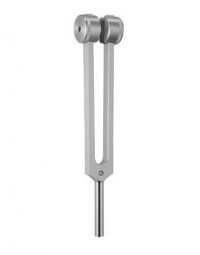
Table of Contents
Frequently Asked Questions
How do I correctly activate and use a tuning fork to ensure accurate diagnostic results?
Proper activation is the critical first step for any tuning fork examination. The correct method is to hold the tuning fork by its stem and strike it gently against a firm, but not hard, surface, such as your elbow or knee . Striking it on a very hard surface like a table can damage the fork and produce unwanted overtones that interfere with the sound quality.
An alternative method is the “snap” technique, where you place your thumb and index finger on the outside of the tines and slide them off the tips, bringing your fingers together to set the fork vibrating . The testing procedure itself varies based on the goal. For a neurological assessment of vibratory sense, the base of a vibrating 128 Hz fork is placed on a bony prominence, such as the dorsum of the patient’s big toe, while they indicate when they can no longer feel the vibration .
For the Rinne test, the base of a vibrating fork (typically 512 Hz) is first placed on the mastoid process until the patient can no longer hear it, and then the still-vibrating tines are held next to the ear canal to compare bone conduction versus air conduction .
In all cases, conducting the tests in a quiet room and giving the patient clear instructions are essential for reliability .
Which frequency is best for neurological assessments versus hearing tests?
The frequency of the tuning fork is paramount, as different frequencies are suited for distinct clinical applications. For neurological assessments, specifically for testing pallesthesia (the perception of vibration), the standard frequency is 128 Hz . This lower frequency produces a strong, palpable vibration that is ideal for evaluating the function of sensory pathways in conditions like diabetic neuropathy .
For hearing assessments, the choice of frequency is more nuanced. While 128 Hz and 256 Hz forks provide greater tactile vibration, they are generally considered less ideal for pure auditory testing due to patient perception of the vibration itself . The 512 Hz tuning fork is widely recommended for the classic Rinne and Weber hearing tests. It is considered the best balance as it provides a pure tone with adequate duration without the excessive tactile vibration that can confound results at lower frequencies . Some sources note that 256 Hz forks are also used in neurological exams, but evidence suggests that 512 Hz offers better reliability for differentiating between conductive and sensorineural hearing loss.
What are the primary diagnostic tests performed with a tuning fork?
The medical tuning fork is a versatile instrument used for several key diagnostic evaluations. In otology and audiology, the two cornerstone tests are the Rinne test and the Weber test.
The Rinne test compares air conduction (sound waves traveling through the ear canal) to bone conduction (sound vibrations traveling through the skull) to detect conductive hearing loss . The Weber test helps lateralize hearing loss; a vibrating fork is placed on the midline of the forehead, and the patient reports in which ear the sound is louder. This helps distinguish between conductive and sensorineural hearing loss .
In neurology, the primary use is for assessing vibratory sense as part of a peripheral neuropathy examination . Beyond these classical applications, tuning forks have other specialized uses. For example, a 128 Hz fork can be used in a tuning fork auscultation test to screen for fractures. In this test, a stethoscope is placed on the bone proximal to a suspected fracture while the vibrating fork is placed distally; a diminished or absent sound conduction suggests a fracture . This versatility underscores the tuning fork’s enduring value as a low-cost, reliable diagnostic tool.

Reviews
There are no reviews yet