
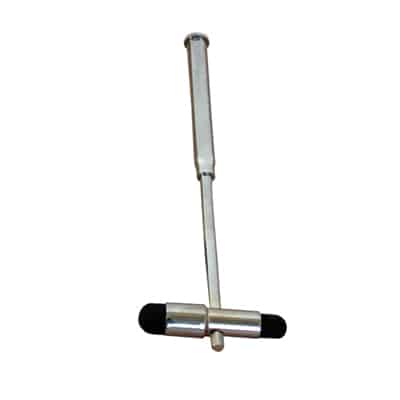
Buck Neurological Hammer
By: Almedic
Discover why the Buck Neurological Hammer is a fundamental and versatile tool in clinical neurology.
The Buck Neurological Hammer, with its distinctive rubberized head and malleable metal handle, is a fundamental and versatile tool in clinical neurology. Its primary application lies in the assessment of the peripheral nervous system through the deep tendon reflex (DTR) exam. The hammer is used to deliver a precise, swift tap to a muscle’s tendon, such as the patellar tendon for the knee-jerk reflex or the brachioradialis tendon in the forearm. The resulting muscle contraction and limb movement provide critical, immediate data on the integrity of the sensory and motor nerve pathways between the muscle and the spinal cord.
The benefits of this specific design are numerous. The dual-ended head, typically featuring a large circular end and a smaller triangular tip, allows for versatility. The larger end is ideal for common reflexes, while the smaller tip is perfect for more focused areas, like testing for clonus at the ankle. The pliable metal handle is a key feature; it can be bent to access difficult-to-reach tendons comfortably, ensuring the practitioner can achieve the correct striking angle for an accurate response. Furthermore, the handle’s flexibility allows it to be used for other diagnostic purposes, such as gently scraping the sole of the foot to test for the Babinski sign in adults—a critical indicator of upper motor neuron dysfunction.
Beyond reflexes, the Buck Neurological Hammer finds application in sensory testing. The rigid tip can be used to assess superficial skin sensitivity, while the rubber head can test vibration sense when placed on a bony prominence. Its simple, durable construction ensures longevity and reliability. In essence, the buck neurological hammer is an indispensable, multi-functional instrument that provides a wealth of diagnostic information, from screening for common neuropathies to identifying serious central nervous system lesions, all through a rapid, non-invasive bedside examination.
Q & A

Table of Contents
Frequently Asked Questions
What is the primary clinical use of the Buck Neurological Hammer?
The Buck Neurological Hammer is fundamentally designed for the assessment of the peripheral nervous system, most commonly through the deep tendon reflex (DTR) examination. This procedure involves delivering a precise, swift tap to specific muscle tendons—such as the patellar tendon below the kneecap—to elicit a reflexive muscle contraction. The observed response, or its absence, provides immediate, critical data on the integrity of the sensory and motor nerve pathways between the muscle and the spinal cord.
This rapid, non-invasive test is a cornerstone of the neurological physical exam, offering essential screening information for conditions ranging from common neuropathies to spinal cord disorders. The hammer’s specialized design is optimized for this core function, ensuring accuracy and reliability in eliciting these vital diagnostic responses.
How does the unique design of the Buck Neurological Hammer enhance its functionality and versatility?
The Buck Hammer’s distinctive design directly addresses the practical needs of a comprehensive neurological examination. Its dual-ended rubber head, featuring both a large circular and a smaller triangular tip, allows for versatility—the larger end is used for common reflexes, while the smaller tip is ideal for focused areas like the ankle. The hallmark pliable metal handle is a critical feature, as it can be bent to achieve the optimal striking angle for difficult-to-reach tendons, ensuring an accurate reflex response.
Furthermore, this flexible handle extends the tool’s utility beyond reflex testing; it can be used to perform the Babinski sign test by gently scraping the sole of the foot. This simple, durable construction transforms it from a single-purpose tool into a multi-functional diagnostic instrument, capable of aiding in both motor and sensory assessments at the bedside.
Can the Buck Neurological Hammer be used for tests beyond checking reflexes?
Absolutely. While renowned for reflex testing, the Buck Neurological Hammer is a versatile diagnostic instrument employed in several additional components of the neurological exam. Its rigid metal tip can be used to carefully assess superficial pain and light touch sensation across the skin. Conversely, the broader rubber head is effective for testing vibration sense when placed firmly on a bony prominence, such as the ankle or wrist.
As previously noted, the malleable handle is also instrumental in performing cutaneous stimulation tests for upper motor neuron signs, like the Babinski response. This multi-application capability makes it an indispensable tool, enabling clinicians to efficiently gather a wealth of diagnostic information—from peripheral nerve function to potential central nervous system lesions—using a single, reliable device.


Reviews
There are no reviews yet