
There are several knee brace types, and each works in a different way. Some mainly compress and warm the joint, some guide the kneecap, and some use rigid hinges to control movement. Choosing between knee brace types starts with the condition, the activity and the level of support needed.
Below we explain how knee braces work and describe the seven main designs in our knee brace range, then briefly cover the other braces and tapes Dunbar Medical supplies to clinics, athletic therapists and teams.
How Knee Braces Work
Orthopedic braces are designed to immobilize or reduce the movement of an injured area, and many also apply compression. By limiting how far muscles, ligaments and bones can move relative to each other, a well-designed brace can help reduce pain, protect healing tissue and lower the risk of the injury coming back.
Braces are also used to prevent injury: some athletes wear a brace for extra support during activity even without a previous injury. Whatever the knee brace types being compared, the same factors decide how well a brace performs:
- Material: what the brace is made of, and whether it is designed to reduce the risk of skin reactions.
- Compression: more compression usually means more support, but it can make the brace less comfortable, so people may wear it less.
- Breathability: how well the skin under the brace can breathe.
- Fit: whether the brace stays in place during activity. A brace that slips cannot control movement as intended.
- Temperature: whether the brace allows the body to regulate its temperature while it is worn.
The 7 Main Knee Brace Types
The knee is the joint where braces are most often worn, and the knee brace types below cover most of the conditions clinicians see, from general knee pain to ligament injuries and osteoarthritis.
1. Knee Sleeves

Knee sleeves are pull-on supports, usually made from neoprene or elastic knit, that provide compression and warmth. They are used for mild pain, minor swelling and general support during sport. Some, such as the Mueller Open Patella Knee Sleeve, have an opening at the kneecap to relieve pressure on it.
2. Knee Stabilizers
Knee stabilizers add side stays or springs to a sleeve or wraparound design for more lateral support. Among knee brace types they sit between a sleeve and a hinged brace, and are often used for mild to moderate ligament sprains or a knee that feels unstable. The Mueller Self Adjusting Knee Stabilizer is a typical example.
3. Hinged Knee Braces

Hinged knee braces have rigid hinges on both sides of the knee that allow it to bend and straighten while limiting side-to-side movement. They are used for ligament injuries such as MCL and LCL sprains, for knees with significant instability, and during return to sport. The Hg80 Hinged Knee Brace is one example.
Some hinged braces have adjustable range-of-motion (ROM) hinges that limit how far the knee can bend, which is useful after surgery. The BioSkin Q Lok ROM combines ROM hinges with kneecap control. Our article on hinged knee brace questions covers how to choose one.
4. Patella Stabilizers
Patella stabilizers use a buttress, pads or straps to keep the kneecap tracking in its groove. They are used for patellofemoral pain and for kneecaps that tend to slip out of place (subluxation). The BioSkin Patella Stabilizer is one option.
5. Knee Straps
Knee straps are narrow bands worn just below the kneecap. They apply pressure to the patellar tendon and are commonly used for jumper’s knee (patellar tendinitis) and Osgood-Schlatter disease. The Mueller Jumper’s Knee Strap is a simple, low-profile example. They are the lightest of the knee brace types.
6. Unloader Knee Braces

Unloader knee braces are the knee brace types designed specifically for knee osteoarthritis that mainly affects one side of the joint. They apply gentle forces that shift load away from the worn compartment, which can help reduce pain during walking and activity. The BioSkin OA Spiral Dynamic Unloading Knee Brace is one example. Read more in our article on unloading knee braces.
7. Knee Immobilizers
Knee immobilizers hold the knee straight and prevent it from bending. They are used for a short period after an acute injury or surgery, when the knee needs to be protected. The Tri-Panel Knee Immobilizer is a typical design.
Choosing Between Knee Brace Types
As a general guide, the knee brace types above line up with common situations like this:
- Mild pain or swelling, general support: knee sleeve.
- Mild to moderate ligament sprain, a knee that feels unstable: knee stabilizer or hinged knee brace.
- After surgery: ROM hinged brace or knee immobilizer, as directed by the surgeon.
- Kneecap pain or tracking problems: patella stabilizer.
- Patellar tendon pain: knee strap.
- Osteoarthritis on one side of the knee: unloader knee brace.
Knee brace types can overlap, and the right choice depends on the diagnosis, so a clinician’s assessment should come first. Our article on why your knee may hurt covers common causes of knee pain, and we also look at choosing a knee brace for a meniscus tear.
Other Braces and Tapes We Supply
Ankle braces restrict the movement of the ankle to let it heal, and can also be worn to help prevent sprains in sports that put the ankle under stress, such as rugby, basketball and volleyball. See our ankle braces and our article on volleyball ankle support.
Back braces limit the movement of the spine. They are used for some progressive conditions and to support the back during heavy lifting. See our back braces.
Elbow braces come as straps and sleeves. A strap worn just below the elbow compresses the upper forearm and is commonly used for tennis elbow and golfer’s elbow; a sleeve adds compression and warmth to the whole joint. See our elbow braces and our elbow brace questions and answers.
Wrist braces immobilize the wrist, and some extend to support the thumb. Common uses include wrist sprains and carpal tunnel syndrome, and thumb-support designs are used for gamekeeper’s thumb and De Quervain’s syndrome. See our wrist braces and our article on wrist support.
Athletic tape is applied directly to the skin to hold joints and muscles in position during activity, either to protect an injured area or to help prevent injury. It can also be combined with a brace for extra stability. Thread count, composition, tensile strength and breathability all affect performance. See our athletic tape and our guide to ankle taping.
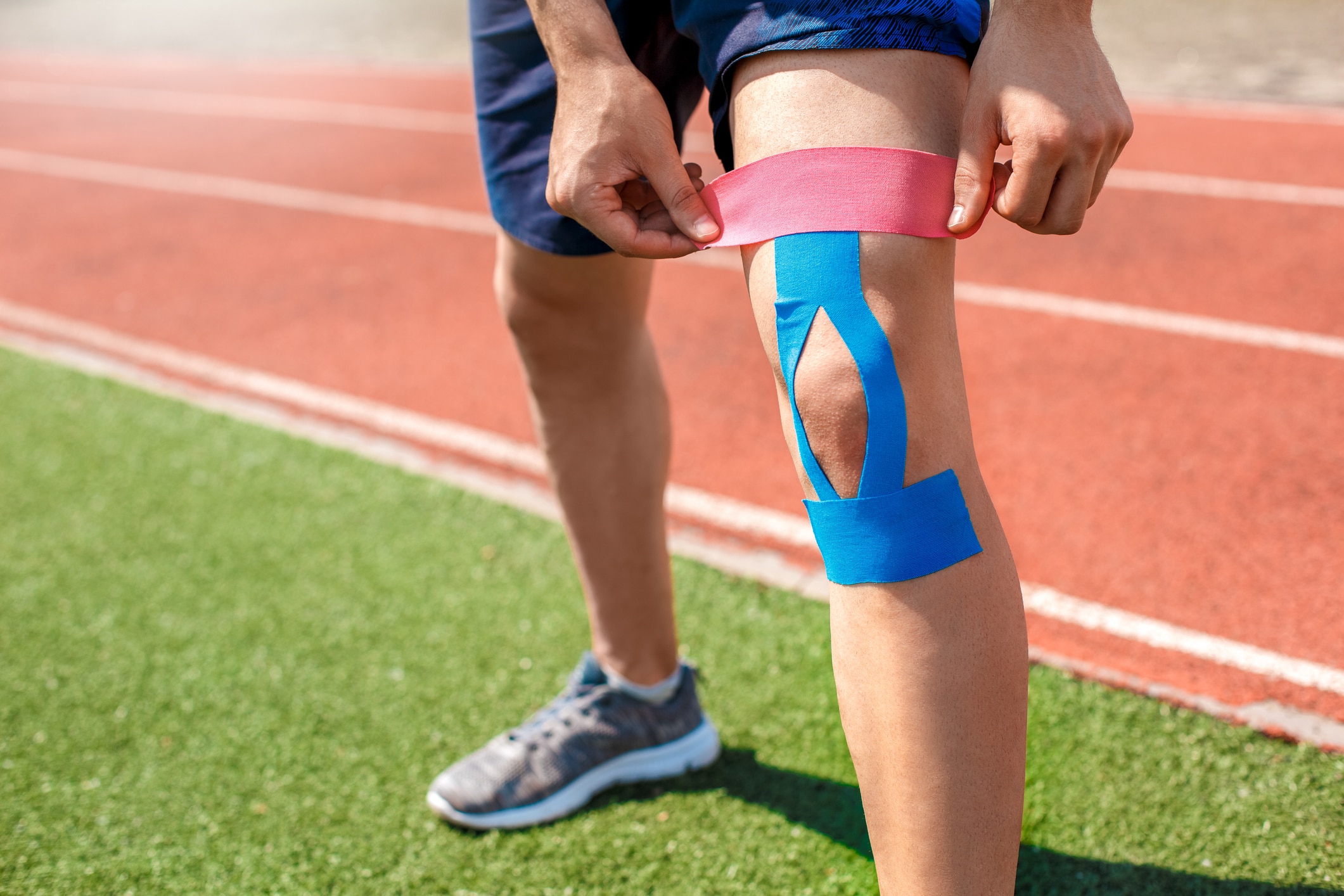
Kinesiology tape is thin and highly elastic. When applied with stretch, it recoils and lifts the skin slightly, and it allows a much wider range of movement than rigid tape. It is usually applied in I, Y or X shapes depending on the size of the muscle. See our kinesiology tape and our article on kinesiology tape for the knee.
Knee Brace Types FAQs
What are the main knee brace types?
The main knee brace types are knee sleeves, knee stabilizers, hinged knee braces, patella stabilizers, knee straps, unloader knee braces and knee immobilizers. They range from light compression to rigid support that controls or prevents movement.
Which knee brace is used for a ligament injury?
It depends on how severe the injury is. Mild sprains are often managed with a knee stabilizer, while more significant instability, or a return to sport after a ligament injury, usually calls for a hinged knee brace. A clinician should assess the injury first.
Can you wear a knee brace all day?
Sleeves and stabilizers are mainly designed for activity, while post-surgery braces and immobilizers are worn as the surgeon or clinician directs. Follow the clinician’s and manufacturer’s instructions, and remove the brace and seek advice if it causes numbness, tingling, increased swelling or skin irritation.