

Ankle Taping: How To Tape An Ankle And When Athletic Taping Helps
Ankle sprains are the most common injury in many sports, and ankle taping is one of the core skills of every athletic therapist and sports physiotherapist. A well-applied tape job limits the inversion that causes most sprains, supports a recovering ligament and gives athletes confidence on return to play.
This guide covers when ankle taping helps, the tapes and supplies you need, how to tape an ankle with a closed basketweave, and when taping or bracing is the better choice.
When Ankle Taping Helps

Ankle taping is most commonly used:
- to reduce the risk of re-injury in athletes returning to sport after an ankle sprain, when the risk of a recurrence is highest;
- to protect ankles in high-risk sports such as basketball, volleyball, soccer and football, where jumping, landing and cutting stress the lateral ligaments;
- as part of rehabilitation, to support a recovering ankle during functional drills; and
- to improve confidence and the athlete’s sense of ankle position.
Rigid tape provides most of its mechanical support early in activity and loosens with sweat and movement, so it is usually reapplied for each practice or game. It works best combined with a balance and strengthening program that addresses the reasons the ankle was sprained in the first place.
Tape And Supplies For Ankle Taping
- Rigid zinc oxide tape for anchors, stirrups and heel locks, such as Cramer 1050i Athletic Tape, Cramer 950 Athletic Tape, Mueller MTape or Renfrew Professional Trainers Tape. Browse all zinc oxide tape.
- Underwrap or prewrap to protect the skin, such as Cramer PreWrap or McDavid Pre Taping Underwrap.
- Adhesive spray, such as Cramer Tuf Skin Spray, to help the tape stay in place.
- Heel and lace pads, such as Cramer Heel and Lace Pads, to reduce blisters at friction points.
- Elastic adhesive tape such as Tensoplast Elastic Adhesive Tape for a more flexible tape job or to finish over rigid tape. Browse all elastic adhesive tape.
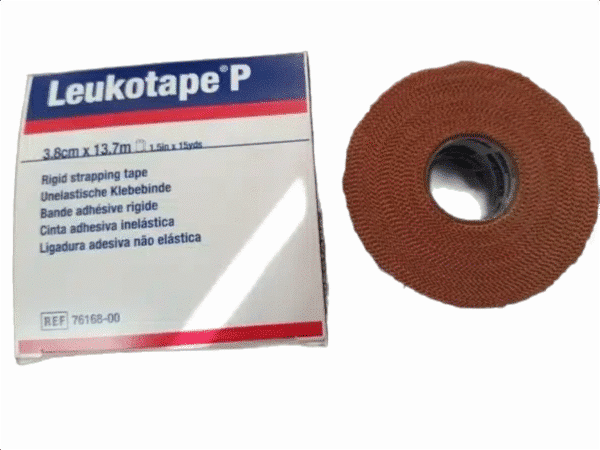
- High-strength strapping tape, such as Leukotape P, for firmer support.
- A tape cutter and remover, such as the Shark Tape Cutter and Mueller Tape & Tuffner Remover Spray, for safe removal.
How To Tape An Ankle: Closed Basketweave
The closed basketweave is the most widely used technique for taping an ankle. The steps below are a summary for trained clinicians; the open textbook Athletic Therapy Skills: Support Techniques describes it in detail.
- Position: have the athlete sit with the leg extended off the table and the ankle at 90 degrees.
- Prepare the skin: make sure the skin is clean and dry, apply adhesive spray, place heel and lace pads, and apply a single layer of underwrap.
- Anchors: apply two anchor strips around the lower leg below the calf muscle, and one around the midfoot without restricting it.
- Stirrups and horseshoes: apply a stirrup from the inside of the leg, under the heel and up the outside, pulling the foot slightly into eversion, then a horseshoe around the back of the heel. Alternate three stirrups and three horseshoes, overlapping each by about half.
- Figure-of-eight: apply a figure-of-eight around the ankle and foot to add support.
- Heel locks: apply a medial and lateral heel lock to control the subtalar joint.
- Close up: cover the remaining gaps with closing strips, then check that the tape job is smooth, with no gaps or wrinkles.
- Check: confirm circulation and sensation in the toes and that the athlete can move comfortably.

Ankle Taping vs Ankle Bracing
Both ankle taping and lace-up or stirrup ankle braces can reduce the risk of recurrent sprains. Taping can be tailored to each athlete and is preferred by many for its feel, but it takes time and skill to apply, needs reapplying for each session and loosens with activity. Braces are reusable, adjustable during play and can be applied by the athlete. Many teams use a combination, taping athletes who prefer it and bracing others.
Other Uses Of Athletic Taping
The same principles apply to taping other joints. Athletic tape is commonly used for thumb and wrist sprains, finger buddy taping, knee support and plantar fasciitis, and kinesiology tape is used for a range of conditions. For more on taping and supplies, see our guide to athletic training supplies.
Frequently Asked Questions
How long does ankle taping last?
Rigid tape loses much of its support during the first part of activity as it loosens with sweat and movement, so it is usually applied fresh before each practice or game.
Should tape be applied directly to the skin?
Tape adheres best on skin, but underwrap is commonly used to protect the skin of athletes taped daily. Use adhesive spray to help it stay in place.
Is ankle taping or an ankle brace better?
Both can help reduce recurrent sprains. The choice often comes down to the athlete’s preference, the sport, and the time and staff available to tape.
How do you remove ankle tape safely?
Use a blunt-tipped cutter along the inside or outside of the ankle, away from bony points, then peel the tape back towards the body while supporting the skin. A remover spray helps with residue.
Taping Supplies For Athletic Therapists And Teams
Dunbar Medical supplies athletic therapists, sports teams and clinics across Canada with athletic tape, underwrap, padding and taping accessories from brands including Cramer, Mueller, BSN, Renfrew and DynaPro. Browse our athletic tape range, or contact our team for product advice.
Conclusion
Ankle taping is a simple, effective way to support recovering ankles and reduce the risk of recurrent sprains. Use good-quality rigid tape, prepare the skin well, follow a consistent technique such as the closed basketweave, and combine taping with a rehabilitation program for the best long-term protection.







This post was really enjoyable