

Clamp Forceps
By: Almedic
Clamp forceps are used to control blood flow in order to cauterize wounds or ligate blood vessels.
Clamp forceps, also called hemostatic forceps, can be used to securely hold tissue and control blood flow (hence the name hemostatic) as part of wound care. In hemostatic mode, they compress blood vessels or other tubular structures in order to restrict blood flow. This then allows cauterization of wounds or ligation of blood vessels to be performed. These forceps are 16 cm long.
Q & A
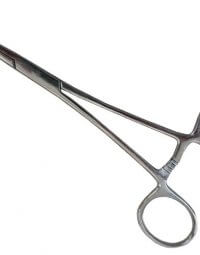
Table of Contents
Frequently Asked Questions
What is the primary difference between hemostatic forceps and other surgical clamps or forceps?
The key distinction lies in their specific design for hemostasis, or stopping blood flow. Unlike tissue forceps, which are used for gentle grasping, or towel clamps, clamp forceps are engineered to securely occlude tubular structures. Their jaw design—often featuring longitudinal serrations and a finely interlocking tip—allows them to grip and compress blood vessels firmly without causing excessive trauma or cutting through the tissue.
This precise compression is facilitated by their ratcheted locking mechanism. Once positioned on a vessel, the handles can be clicked into progressively tighter positions to apply controlled, consistent pressure. This temporarily halts blood flow, creating a clear and dry surgical field. This specialized function makes them indispensable not just for clamping vessels prior to ligation or cauterization, but also for blunt dissection and as a temporary clamp during various procedures.
How do I select the correct type and size of clamp forceps for a procedure?
Selection is based on the anatomical site, vessel size, and procedural depth. The most common distinction is between curved and straight jaws. Curved forceps, like the Kelly or Crile, are ideal for deeper cavities, as the curve allows the tip to slide around a vessel for safer isolation before clamping. Straight forceps are often preferred for superficial vessels or when a direct, vertical approach is needed.
Size and tip design are equally critical. For general use on small to medium vessels, standard 12.5cm to 16cm forceps (like the 16cm model described) are common. Finer, more delicate tips, such as those on Halsted mosquito forceps, are used for precise work on small vessels in confined areas. Choosing an instrument proportionate to the task minimizes tissue damage and ensures effective occlusion.
How are clamp forceps properly sterilized, maintained, and inspected for safety?
Sterilization is almost exclusively achieved via autoclaving using steam under pressure, as these are reusable, critical surgical instruments. Proper maintenance begins immediately after use with thorough cleaning to remove all biologic material, followed by lubrication of the box lock and ratchet to prevent sticking and corrosion.
Prior to sterilization and each use, a detailed inspection is mandatory. This involves checking the jaw alignment—they must meet evenly along their entire length when closed. The ratchet mechanism must engage and disengage smoothly at each notch without slipping. Finally, the instrument integrity must be assessed for any cracks, pits, or signs of fatigue, especially at the box lock. A compromised forceps can fail during a procedure, with serious consequences for patient safety.


Reviews
There are no reviews yet