

Guedel Emergency Airway Kit
By: Almedic
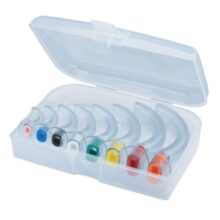
Almedic’s guedel emergency airway kits are for use on an unconscious patient to help him or her maintain an airway. Please note – the product image shown on this page includes all the available sizes. However, the airways are sold and priced individually and not in groups.
These guedel or emergency airway kits are for use on an unconscious patient to help him or her maintain an open oropharyngeal airway. They are available in 9 color coded sizes (for flexible units) and 8 color coded sizes (for slightly flexible units).
Guedel airways are sometimes alternatively called guedel pattern airways or oropharyngeal airways (OPA).
These airways are designed to be inserted through the patient’s mouth. They help to to keep the tongue from occluding the upper airway (as can happen when an individual loses consciousness). By doing this, they help to permit the passage of oxygen through to the lungs.
Each guedel airway consists of a hollow large diameter curved plastic tube with a protruding rim at the end to be inserted into the mouth. Upon insertion into the mouth, the flange of the tube rests against the lips. The curvature of the tube follows the contour of the tongue and the distal end of the airway opens into the patient’s pharynx.
The product image shown on this page includes all the available sizes. However, the airways are sold and priced individually and not in groups.
Sizes available are 40mm (pink), 50mm (blue), 60mm (black), 70mm (white), 80mm (green), 90mm (yellow), 100mm (red), 110mm (light blue) and 120mm (purple or orange).
You can also purchase emergency airways in Flexible or Slightly Flexible form. They are 100% latex free, so no need to be concerned about adverse reactions from those with latex sensitivities.
Guedel Emergency Airway – Intended Use
Healthcare professionals can use these airways for:
- Resuscitation of a patient;
- Treating an unconscious patient by facilitating his/her breathing;
- Treating an unconsciousness patient by facilitating suctioning through the airway.
When Should A Guedel Airway Not Be Used?
In general, these airways should be used only on unconscious patients. if used on conscious or semi conscious patients, they may trigger a gag reflex that could cause the patient to vomit and his/her airway to again be obstructed. For a conscious or semi conscious patient, the use of a nasopharyngeal airway is instead indicated.
When treating a patient with a guedel airway, healthcare professionals should take appropriate isolation precautions, such as wearing a CPR face mask.
Q & A

Table of Contents
Frequently Asked Questions
How do I select the correct size of Guedel emergency airway for a patient?
Selecting the appropriate size is critical for the device to function effectively and safely. An incorrectly sized airway can either be ineffective or cause further harm. The standard method for sizing is to measure the device against the patient’s anatomy. To choose the correct length, hold the airway against the side of the patient’s face with the flange aligning with the center of the mouth. The tip of the airway should reach the angle of the jaw. Alternatively, you can measure from the corner of the patient’s mouth to the earlobe; this distance corresponds to the appropriate airway length.
Guedel airways are color-coded by size for quick identification, ranging from 40 mm (pink) to 120 mm (purple or orange). For pediatric patients, sizes 40 mm to 70 mm are typically used, while adult patients generally require sizes 80 mm to 120 mm. If the airway is too long, it can press the epiglottis against the laryngeal opening, causing obstruction. If it is too short, it will not hold the base of the tongue forward, leaving the airway blocked.
When is it contraindicated to use a Guedel emergency airway?
Guedel airways are specifically designed for use in unconscious patients. The primary contraindication is its use on a conscious or semi-conscious patient who still has an active gag reflex. Inserting the device into a patient with an intact reflex can stimulate the back of the throat, triggering laryngospasm or severe gagging. This often leads to vomiting, which poses a high risk of aspiration and can re-obstruct the very airway the device is meant to protect.
Therefore, a proper assessment of the patient’s level of consciousness is mandatory before insertion. For conscious or semi-conscious patients who require airway support, a nasopharyngeal airway (NPA) is the preferred alternative, as it bypasses the oral cavity and is generally better tolerated. Furthermore, healthcare professionals should always ensure they are using proper personal protective equipment, such as a CPR face mask, to maintain isolation precautions during treatment.
What is the proper insertion technique for an oropharyngeal emergency airway?
Correct insertion technique is essential to avoid pushing the tongue further back into the pharynx. Before insertion, the patient’s mouth should be cleared of any obvious obstructions or secretions. The technique varies slightly depending on the patient’s age. For adults, the airway is typically inserted upside down, with the tip pointing toward the roof of the mouth. It is advanced gently until it passes the soft palate. At this point, the device is rotated 180 degrees so that it curves downward, following the natural contour of the tongue. This rotation ensures the distal end sits in the pharynx, just above the epiglottis, while the flange rests comfortably against the patient’s lips.
For infants and children, the airway should be inserted right-side up using a tongue depressor to avoid damaging the delicate oral structures. Once in place, the device holds the tongue forward, creating a patent channel for air to pass through to the lungs. Proper placement is verified by observing chest rise and feeling for airflow, ensuring the passage of oxygen is unobstructed.






Reviews
There are no reviews yet