
Anatomical Charts
Discover why these Anatomical Charts excel at combining academic rigor with everyday practicality.
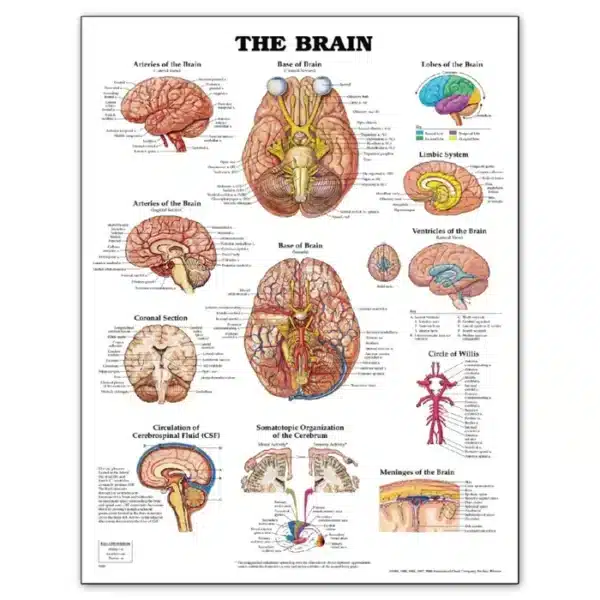
These Anatomical Charts are robust and visually detailed educational tools, designed for clarity and durability. Printed in full-color on a heavy-duty, markable surface, it presents complex anatomical systems with precise scientific accuracy. The chart’s convenient, portable format belies its sturdy construction, making it suitable for high-traffic environments.
A key feature is its practical functionality: the surface allows for writing or drawing with dry-erase markers, facilitating interactive learning. Notes and diagrams can be wiped clean with ease, enabling dynamic, repeated use without damage to the vivid underlying imagery. This wipe-on, wipe-off capability transforms it from a passive reference into an active demonstration aid.
The chart’s primary strength is its versatility across multiple settings. For students and medical trainees, it serves as an ideal study companion for mastering intricate bodily structures. In clinical or therapeutic contexts, it becomes an invaluable resource for client education, allowing professionals to clearly illustrate conditions and procedures. Its utility extends to classrooms and gyms for instructional demonstrations.
Available in a focused series, these Anatomical charts cater to specific educational needs. Rather than a generalized overview, you can select a chart dedicated to a particular anatomical system—such as muscular, skeletal, nervous, or circulatory—ensuring the content is exactly tailored to your subject matter. This specialization provides in-depth detail where it is most required.
These Anatomical Charts combine academic rigor with everyday practicality. It is an excellent investment for personal knowledge enhancement, as well as a professional-grade instrument for training and patient communication, all contained within a single, resilient, and interactive visual resource.
Q & A
 Anatomical Charts
Table of Contents
Frequently Asked Questions
How durable and practical is the dry-erase surface of the anatomical chart for repeated use?
The chart is specifically engineered for heavy, interactive use. Its surface is not merely laminated but is a proprietary, heavy-duty material designed to be marked upon with standard dry-erase markers and wiped clean repeatedly without ghosting, staining, or degradation. The vivid, high-resolution print is protected beneath a durable coating, ensuring that the underlying anatomical artwork remains pristine and legible even after countless cycles of writing and erasing. This makes it fundamentally different from a standard paper poster, transforming it into a dynamic teaching aid where structures can be highlighted, pathways drawn, and notes added during explanations, then cleared for the next session.
What specific anatomical systems are available in the series?
Unlike a generalized overview chart, this product line is offered as a focused series, with each volume dedicated to illustrating a single system in profound detail. This allows for targeted education. Available titles typically include specialized anatomical charts for the muscular system, skeletal system, nervous system, circulatory system, and visceral organs, among others. Each chart in the series leverages its dedicated canvas to delve deeper, showcasing intricate relationships, specific muscle origins/insertions, detailed nerve pathways, or the complexities of vascular flow with a clarity that a composite chart cannot achieve. This specialization ensures educators and professionals can select the exact tool for their specific instructional needs.


Reviews
There are no reviews yet