
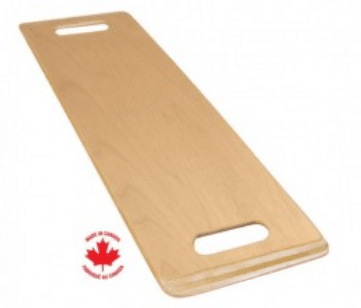
Transfer Board
By: Parsons ADL
| Product Dimensions | 9″ x 28″ x 0.5″ |
|---|
Use this transfer board to facilitate safe and effortless patient transfers from a wheelchair to a bed, toilet or even a car seat.
This Parsons ADL Transfer Board with Hand Holes is designed for safe and effortless patient transfers.
The board features convenient hand holes at each end for easy carrying and positioning. Crafted from multi-laminated birch plywood with a smooth, durable lacquer finish, it offers both strength and a low-friction surface. The tapered ends and rounded edges allow the board to slide smoothly on and off surfaces. With a thickness of just 1/2″ (13 mm) and a weight capacity of 250 lbs (114 kg), it provides reliable support in a lightweight, easy-to-use design.
| Product Dimensions | 9″ x 28″ x 0.5″ |
|---|
Q & A

Table of Contents
Frequently Asked Questions
What is the weight capacity of the transfer board, and is it suitable for bariatric patients?
The Parsons ADL Transfer Board with Hand Holes has a manufacturer-rated weight capacity of 250 lbs (114 kg). This specification is based on the board’s construction from multi-laminated birch plywood, which provides excellent structural integrity for its thickness of just 1/2 inch (13 mm).
While this capacity makes the board suitable for many average-sized adults, it is not designed for bariatric use. Patients or caregivers seeking a board for individuals exceeding 250 lbs should consider a model specifically rated for higher weights. It is always important to adhere to the stated limit to ensure patient safety and prevent board flexing or failure during transfer.
That said, for the intended user population, the board offers a favorable strength-to-weight ratio. Its lightweight design reduces caregiver strain, while the durable lacquer finish and low-friction surface enable smooth, controlled slides. The tapered ends further assist with initiating movement without excessive force. Always assess the patient’s weight and mobility level before selecting this device.
How do the hand holes improve safety and ease of use during transfers?
The integrated hand holes at each end of the transfer board serve multiple critical functions that enhance both patient and caregiver safety. First, they provide secure gripping points for positioning the board beneath the patient. Instead of grasping the board’s edges—which can lead to pinched fingers or unstable placement—the caregiver can insert their hands directly into the cutouts for a controlled, ergonomic hold.
Second, the hand holes allow for easy extraction of the board once the transfer is complete. After the patient has moved from one surface to another, the caregiver can hook a finger into the exposed hole and smoothly pull the board out from under the patient without disturbing their seated position. This reduces the risk of sudden shifts or falls.
Finally, the holes facilitate carrying the board to and from storage locations, promoting proper handling technique. When used correctly, the hand holes transform what could be a clumsy two-handed slide into a precise, low-effort maneuver. They are a thoughtful design feature that directly addresses common user complaints about transfer boards slipping or being difficult to retrieve after use.
What surfaces is this transfer board compatible with, and does it scratch or damage furniture?
The Parsons ADL Transfer Board is designed for use between two firm, level surfaces of similar height, such as a bed and a wheelchair, an exam table and a stretcher, or a car seat and a wheelchair. The board requires a minimum of several inches of overlap on each surface to remain stable during the transfer. It is not intended for use with soft, uneven, or overly tall surfaces like couches or high-backed chairs.
Regarding surface damage, the board features a smooth, durable lacquer finish that minimizes friction. While this finish is gentle on most fabrics and vinyl upholstery, no transfer board is entirely risk-free. Prolonged or repetitive sliding may cause minor wear on very delicate materials. To prevent potential damage, caregivers should ensure the board is clean and free of debris before each use, as trapped dirt or grit can act as an abrasive.
The rounded edges and tapered ends also help prevent gouging or catching on surface edges. For most standard wheelchair cushions and bed linens, the board will glide without leaving marks. However, it is always wise to inspect both the board and the transfer surfaces periodically. If extreme sensitivity is a concern, placing a thin, smooth cloth over the board can offer additional protection without significantly increasing friction.


Reviews
There are no reviews yet