
Tongue Depressors
By: Alliance
| Priced Per | Pack of 100 |
|---|
Used for examination of the tongue and throat. Available in sterile (wrapped) and non sterile (unwrapped). Each depressor is 6″ long.
Alliance Tongue Depressors can be used to depress the tongue to allow examination of the mouth and throat. Both sterile and non sterile variations are available. 6″ long. 100/Box. Single use only. Sold as a pack of 100 depressors.
| Priced Per | Pack of 100 |
|---|
Q & A
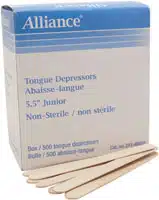
Table of Contents
Frequently Asked Questions
What is the practical difference between the sterile and non-sterile tongue depressor variations, and when should I use each?
The primary distinction lies in the intended clinical application and the required barrier precautions. The sterile variation of the Alliance Tongue Depressor is individually wrapped and subjected to a rigorous sterilization process to eliminate all viable microorganisms. These are mandatory for use in sterile fields, during surgical procedures, or when examining patients with compromised immune systems, open wounds in the oropharyngeal region, or when there is a risk of breaching mucous membranes. The sterile packaging ensures that the device introduces no contaminants to the patient environment.
Conversely, the non-sterile variation is intended for general examination purposes where the integrity of the skin or mucous membrane remains intact. In a standard outpatient setting—such as a routine sore throat evaluation or a school physical—the non-sterile tongue depressor is the standard of care, provided it is stored in a clean, closed container. It is critical to remember that regardless of the sterility level, both variations are strictly single-use. Reusing either type, even after attempted cleaning, compromises infection control protocols and patient safety due to the risk of cross-contamination.
Why is the tongue depressor "single use only" specification emphasized, and what are the risks of reusing them?
The “single use only” designation is a critical infection control mandate, not merely a suggestion. Tongue depressors are classified as critical items when they contact mucous membranes; they can easily absorb fluids such as blood or saliva. Even if a depressor appears visibly clean, it can harbor microscopic pores that retain bacteria, viruses (including Hepatitis B and C, and Herpes simplex), and fungi. Attempting to sterilize a wooden or bamboo depressor after use is unreliable, as the porous material prevents sterilizing agents from penetrating fully, rendering autoclaving or chemical soaking ineffective.
Using a single tongue depressor on multiple patients—or even reusing one on the same patient after it has been set down—creates a direct vector for pathogen transmission. For facilities, violating single-use protocols exposes patients to healthcare-associated infections (HAIs) and exposes the practice to significant regulatory and liability risks. The Alliance Tongue Depressors are engineered for a single examination episode; they are cost-effective enough to ensure that compliance with this safety standard is always the most practical and responsible choice for the practice.
How does the 6-inch length and material construction benefit clinical examination?
The 6-inch length of the Alliance Tongue Depressor is an industry standard specifically designed to optimize both leverage and visualization. This length provides sufficient reach to depress the posterior third of the tongue without requiring the clinician’s fingers to encroach upon the patient’s oral aperture, thereby maintaining a safe distance from the airway and reducing the patient’s natural gag reflex. It offers the ideal balance: long enough to provide adequate leverage against the tongue’s muscular resistance, yet short enough to prevent accidental over-insertion toward the oropharynx.
Regarding construction, these depressors are manufactured from high-quality, splinter-resistant wood or bamboo. This material choice is deliberate; it offers the necessary rigidity to hold the tongue down firmly against muscular resistance, which is essential for a clear view of the tonsils, uvula, and posterior pharyngeal wall. Unlike metal or rigid plastic alternatives, the wooden construction is gentle on dental enamel and soft tissues. Furthermore, the tactile feedback provided by the material allows the clinician to gauge the appropriate amount of pressure needed, ensuring a thorough examination while maintaining patient comfort and safety.





Reviews
There are no reviews yet