

Plastic Goniometer
By: Almedic
Used to measure the range of motion of a joint. Available in 180 degrees or 360 degrees.
A plastic goniometer can be used to measure the range of motion of a joint. This in turn provides information that a healthcare professional can use to:
- Determine the presence of dysfunction related to muscles, tendons or joints (such as may be caused by a knee sprain, for example);
- Make a diagnosis as to the underlying condition;
- Develop treatment goals;
- Evaluate the progress the patient is making in recovering from the condition (or the lack of progress);
- Decide on treatment modifications (if these are necessary).
Plastic goniometers can also be used to measure angle when fabricating an orthosis to treat a particular joint dysfunction.
Q & A
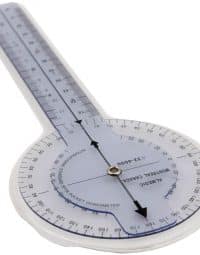
Table of Contents
Frequently Asked Questions
How Accurate and Reliable is a Plastic Goniometer for Clinical Use?
This is a primary concern for healthcare professionals who depend on precise data to diagnose conditions and track patient progress. The accuracy of a standard plastic goniometer is generally well-regarded in clinical settings. Studies have shown that when used correctly, measurements from a conventional plastic goniometer have a high level of accuracy, comparable to more advanced technological devices .
However, it is important to acknowledge that the reliability of any goniometric measurement can be variable . This variability is often not due to the tool itself but rather the user’s technique. Factors such as the correct identification of anatomical landmarks, precise alignment of the goniometer’s arms, and consistent patient positioning are crucial for obtaining repeatable results . To mitigate this, clinicians are encouraged to familiarize themselves thoroughly with standardized measurement protocols, as this can significantly reduce variability and enhance the reliability of their assessments .
What is the Correct Way to Use a Plastic Goniometer?
Proper technique is essential to harness the full diagnostic potential of a goniometer. The process involves a systematic approach to ensure the measurement reflects the true range of motion.
First, the patient should be positioned comfortably, with the joint of interest exposed and the surrounding muscles relaxed . The clinician then locates and typically marks the specific bony landmarks around the joint. The goniometer is positioned by placing its fulcrum (the center of the instrument’s circle) directly over the joint’s axis of rotation. One arm of the goniometer is aligned with the proximal bone (closer to the body’s center), and the other arm is aligned with the distal bone .
The joint is then moved slowly through its full, pain-free range of motion. The final angle is read from the scale, using the arm that moved in relation to the stationary arm. The transparent design of plastic goniometers is particularly beneficial here, as it allows for an unobstructed view of the joint’s axis throughout the movement, thereby enhancing accuracy .
How Do I Choose the Right Plastic Goniometer for My Needs?
Selecting the appropriate goniometer depends on the specific joints you intend to assess and the setting in which you work. For clinical and rehabilitation environments, a standard 12-inch, 360-degree goniometer is a versatile choice, suitable for measuring most major joints, including the knee, elbow, shoulder, and hip . The longer arms on such a model provide better leverage and alignment for these larger joints .
For smaller joints, like those in the fingers (MCPs, PIPs, DIPs), a smaller, specialized finger goniometer with a more compact range is necessary . When making a selection, look for features that promote accuracy and ease of use, such as a clear, medical-grade plastic construction for visibility, a head calibrated to the ISOM (International Standards of Measurement) system, and scales that are easy to read, ideally with dual-sided markings . For basic tracking and home use, a simpler, durable plastic model may suffice, but it is always advisable to seek guidance from a healthcare professional for proper interpretation of measurements .
Reviews
There are no reviews yet