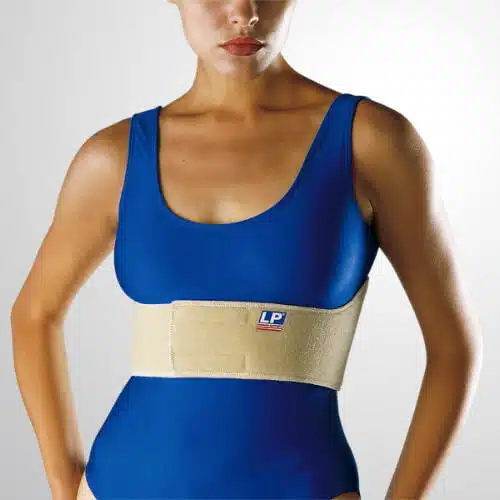
Dunbar Medical supplies rib belts and rib braces to clinics, athletic therapists and sports teams across Canada. We carry the LP Support rib belt in men’s and women’s sizes: an elastic rib belt (also called a rib binder or rib brace) that gives gentle support to the chest wall after a rib bruise or intercostal muscle strain.
The LP Rib Belt compresses the thoracic area following surgery or rib fractures and also restricts rib motion and chest expansion. The belt has an adjustable hook and loop closure for easy application and is available in male and female versions.
A rib support can ease pain from injuries such as an intercostal muscle strain or bruised ribs, and support the chest wall while they heal.
They can support the rib cage during recovery from injury. In some cases they are used to promote recovery from surgery in the rib cage area. These devices are also called rib belts. Some people also refer to a rib support as a rib binder or a rib compression wrap.
The better rib supports available on the market will have the following features:
A low profile that allows the rib belt to be worn discretely under regular clothing without sacrificing their effectiveness;
Breathable materials that allow the body to maintain its natural temperature without undue temperature increases with the resultant perspiration and discomfort.
Some of the other things you can do to heal faster in addition to wearing your rib support are:
Avoid physically demanding sporting or athletic activities until you have recovered fully and your doctor advises that you can return to these activities;
Use a cold pack on the area from time to time to ease the pain;
Avoid taking short breaths while you are wearing a rib belt. Try to breathe deeply instead. If you avoid doing so, you could increase your risk of developing pneumonia.
We would also suggest that you consult with your doctor before you decide to wear a rib support. Depending on the exact nature of your injury, your doctor may advise against wearing one.
Using a Rib Belt Safely
A rib belt should be snug enough to support the chest wall but loose enough for the patient to take full, deep breaths. Current guidance generally advises against tight binding for rib fractures because shallow breathing raises the risk of chest infection, so a rib belt for a suspected fracture should be used only on a doctor's advice. Anyone with chest pain, shortness of breath or a suspected fracture needs medical assessment first. See also back braces and cold packs.