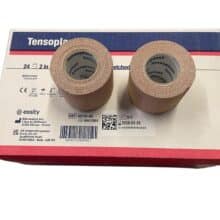
Heavyweight elastic adhesive tape is thicker than its lightweight counterpart and provides more tensile strength and support after application. In fact, the heavyweight elastic tapes may require the use of scissors to cut the tape from the roll before application to the body. Lightweight elastic tapes offer less interference to movement and are easier to wear while performing athletic or sporting activities.
These bandages are suitable for treating and managing unstable joints or soft tissue injuries such as sprained knees or wrists.
Elastic adhesive tapes offer the advantage of making it easier to tape highly contoured body areas with no loss of support or compression. Their elasticity helps them to conform more closely to these areas.
You can get elastic adhesive bandages either with or without latex. Latex free tapes are the safer choice for anyone with a latex allergy, and are worth considering for sensitive skin.
How To Assess The Quality Of An Elastic Adhesive Tape
As with athletic tapes in general, the quality of elastic adhesive tapes is largely determined by:
- The number of longitudinal and vertical fibres per inch in the backing of the tape. A higher thread count generally gives a stronger, more even tape;
- The quality of the adhesive, which should be able to withstand moisture, perspiration and adverse weather conditions. It also needs to withstand powerful and sudden body and joint movements while in use by the athlete;
- Ease of removal of the tape without too much discomfort to the athlete;
- The roll tension, which should be uniform and fluid while the tape is being removed from the roll.
Elastic Adhesive Tape Widths
Typical elastic adhesive tape widths are 1”, 2”, 3” and 4”. Most of these tapes come in 5 yd lengths.
Tapes with widths of 1” and 2” are more suitable for smaller parts of the body such as the wrist, fingers or elbow. They are also appropriate for use on any of the limbs of a small child.
The 3” and 4” width tapes are appropriate for use on the larger body parts of an adult. These might include, for example, knees, shoulders and the ankle.