

Shoulder Pulley
By: DynaPro Health
Sale ends Nov 30Use the DynaPro Shoulder Pulley for exercises that will improve your shoulder range of motion as you recover from shoulder bursitis, frozen shoulder or a rotator cuff injury.
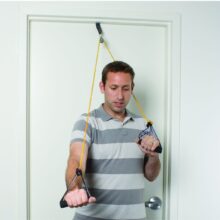
The DynaPro Shoulder Pulley will help you recover from injuries like a frozen shoulder, shoulder bursitis or injured rotator cuff by gradually strengthening the shoulder joint and increasing your range of motion. You can also use it to strengthen your shoulder and reduce the risk of future injuries. It is essentially a rope terminated with handles and equipped with small pulley system. There is also a stopper end. You can easily hang this device over a door at home (using the stopper end) and carry out a wide range of shoulder pulley exercises with it.
Although the DynaPro Shoulder Pulley is suitable for home use, please use it under the supervision of your physiotherapist or other health care advisor. It is easy to re injure your shoulder if you increase the level of difficulty of your exercises too quickly.
Shoulder Pulley Exercises
You can use this pulley to perform the following rehabilitative shoulder exercises, among others:
Shoulder Flexion
Hang your shoulder pulley over a door and stand with your back to it. Hold the handles of the pulleys with one in each hand. Then pull the handle on your non painful side down. This will lift your other hand. Allow it to move up and focus on keeping your elbow straight. Lift your injured arm up as far as possible and stop once you start to feel pain. Keep your injured arm in the raised position for two seconds and then use the pulleys to slowly lower it to your side. Repeat 10 times.
Shoulder Abduction with your Shoulder Pulley
Stand with your back to the door and with the shoulder pulley hanging over the door. Once again, hold the pulley handles one in each hand. Pull down the handle on your healthy side. Allow the pulley action to lift your injured arm out to the side. Keep the elbow on your injured side straight and continue lifting until you start to feel a strain in your shoulder. Hold for two seconds and then slowly lower your injured arm back down to your side. Repeat 10 times.
Shoulder Internal Rotation
Stand with your back to the door and hold the shoulder pulley handles with one in each hand. Keep your injured shoulder rotated slightly inward and allow the hand on the same side to rest comfortably behind your hip or lower back. Pull down with the handle in your healthy arm and allow the injured arm to be raised behind your back. Continue until you feel a slight strain and then hold for two seconds. Then lower the arm back down to your side. Repeat 10 times.
Q & A

Table of Contents
Frequently Asked Questions
How do I properly set up the DynaPro Shoulder Pulley on a door?
Proper setup is crucial for both safety and the effectiveness of your exercises. The DynaPro Shoulder Pulley is designed for easy at-home use, primarily by hanging it over a sturdy door. To begin, open the door you intend to use and place the specially designed “stopper end” of the pulley system on the opposite side of the door’s top edge. This stopper is a crucial component; it is a soft, often ball-shaped, piece that prevents the pulley from sliding or falling through the gap when the door is closed.
Once the stopper is securely in place on the top of the door, you can gently close it. Before starting any exercise, give the pulley a firm, gentle tug to ensure the door is holding it securely and it will not slip during your routine. The door should be closed completely, creating a tight grip on the stopper. It is also highly recommended to ensure the door you are using can be locked or latched shut. This prevents someone from accidentally opening it from the other side and causing the pulley to fall during your exercise. After the device is securely mounted, you can adjust your stance and distance from the door to control the tension and movement range for your specific exercise.
What exercises can I perform with the shoulder pulley, and how do I do them correctly?
The DynaPro Shoulder Pulley is a versatile tool for performing a range of rehabilitative exercises that target different planes of shoulder motion. Your physiotherapist or healthcare advisor will prescribe the specific movements right for your condition, but common exercises include shoulder flexion, abduction, and internal rotation.
For Shoulder Flexion, you typically stand with your back to the door. Hold a handle in each hand, and with your elbows straight, use your healthy arm to pull down on its handle. This action will gently and passively lift your injured arm forward and upward. You should lift until you feel a gentle stretch, but crucially, stop before you feel any sharp pain. Hold the raised position for a couple of seconds, then use your healthy arm to control the descent of your injured arm back down.
Shoulder Abduction follows a similar principle, but you stand with your injured side closer to the door. As you pull down with your healthy arm, the pulley lifts your injured arm out to the side, away from your body, keeping the elbow straight.
Shoulder Internal Rotation involves standing with your back to the door and allowing the hand of your injured side to rest behind your lower back. Pulling down with the healthy arm will then gently lift the injured arm upward behind your back. For all exercises, the key is to use the healthy arm to do the work, allowing the injured arm to remain completely relaxed and passive. The movement should be slow, controlled, and always within a pain-free range of motion as advised by your healthcare professional.
How often should I use the shoulder pulley, and how do I know if I'm progressing too quickly?
The frequency and intensity of your shoulder pulley exercises must be guided by a physiotherapist or healthcare advisor, as they will tailor a program to your specific injury and recovery stage. However, a general guideline for many conditions, such as a frozen shoulder or rotator cuff injury, is to perform the exercises once or twice daily. Each exercise is typically repeated in a set of 10 repetitions, and you may be advised to complete several sets. Consistency is more important than intensity.
The pulley is designed for passive range-of-motion exercises, meaning you are not actively using your injured muscles to lift the arm; the goal is to gently stretch and maintain mobility. Regarding progression, the most important rule is to listen to your body. You should never push through sharp or intense pain. The sensation during exercise should be one of a mild, comfortable stretch.
It is easy to re-injure yourself by increasing the difficulty too quickly. Signs you may be progressing too fast include pain that persists or worsens after your exercise session, a significant decrease in range of motion the next day, or a sharp, catching pain during the movement. If you experience any of these, you should scale back the intensity—perhaps by not lifting the arm as high or performing fewer repetitions—and consult your healthcare provider. Patience is vital; slow, steady progression is the safest path to a full recovery.

Reviews
There are no reviews yet