

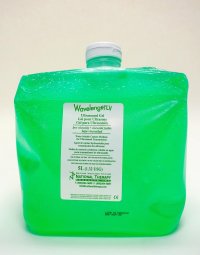
WaveLength Green UltraSound Gel, Low Viscosity
| Colour | Green |
|---|
Wavelength Green Ultrasound Gel is a thin and runny gel for use as a conductive agent in therapeutic ultrasound, diagnostic imaging and other external procedures. It uses a bacteriostatic formula that inhibits growth of bacteria and is also free of salt, alcohol and fragrances.
Wavelength Green Ultrasound Gel is a low viscosity gel designed for use as a conductive agent in therapeutic ultrasound, diagnostic imaging and other external procedures for which a thinner and more runny medium is required. It has excellent lubrication and glide capability and can spread uniformly without running or drying.
The gel is supplied in the following types of packaging:
- a 3.78L Jug;
- 5L Uni-Pac Cube (includes 250 ml dispenser bottle);
- 100 ml tube;
- 250 ml bottle;
- 500 ml bottle; or
- 1L bottle.
Wavelength Green UltraSound Gel – Additional Features
- 100% free of salt, alcohol and fragrances;
- Uses an advanced water soluble, hypoallergenic and bacteriostatic formulation that will inhibit the reproduction and growth of bacteria;
- Optimal conductivity;
- Non corrosive;
- Uses convenient & recyclable packaging
| Colour | Green |
|---|
Q & A
The materials provided by the manufacturer do not indicate the specific viscosity. However, this gel is suitable for ultrasound applications requiring a thinner (more runny) gel for best results. Low viscosity gel is often used in ultrasound applications where enhanced penetration and minimal friction are required. Some ultrasound applications that may benefit from low viscosity gel include:
1. Diagnostic Imaging: In diagnostic ultrasound imaging, low viscosity gel may be used when scanning areas that are difficult to penetrate due to high bone density or tissue density. It allows for better transmission of ultrasound waves through the skin and deeper into the tissue, resulting in clearer imaging.
2. Vascular Ultrasound: When performing vascular ultrasound studies to evaluate blood flow in arteries and veins, low viscosity gel can help improve the accuracy of measurements by reducing interference from surface friction. It allows for smoother movement of the ultrasound probe over the skin, enhancing visualization of blood vessels.
3. Musculoskeletal Ultrasound: In musculoskeletal ultrasound examinations, such as assessing soft tissue injuries or joint abnormalities, low viscosity gel may be preferred to facilitate better visualization of underlying structures. It helps to minimize distortion and improve the clarity of ultrasound images.
4. Interventional Ultrasound: During interventional ultrasound procedures, such as guided injections or biopsies, low viscosity gel can aid in accurate needle placement by reducing the resistance encountered when advancing the needle through the skin and surrounding tissue. This can improve procedural outcomes and patient comfort.
5. Pediatric Ultrasound: When performing ultrasound scans on pediatric patients, using low viscosity gel can help minimize discomfort and skin irritation, as it provides smoother contact between the ultrasound probe and the child's skin. It may also improve patient compliance during the procedure.
Overall, low viscosity gel is particularly useful in ultrasound applications where optimizing acoustic transmission, reducing friction, and enhancing patient comfort are priorities.
Table of Contents
Frequently Asked Questions
Is Wavelength Green Ultrasound Gel safe for sensitive skin or patients with allergies?
Yes, Wavelength Green Ultrasound Gel is specifically formulated for safety and biocompatibility. It is 100% free from common irritants such as salt, alcohol, and fragrances. The gel utilizes an advanced, water-soluble, and hypoallergenic formulation, making it suitable for patients with sensitive skin. Furthermore, it incorporates a bacteriostatic agent, which inhibits the reproduction and growth of bacteria within the gel, promoting a higher standard of patient care and reducing the risk of cross-contamination during procedures.
What makes this gel "low viscosity," and when should it be used?
Low viscosity refers to a thinner, more fluid consistency compared to standard ultrasound gels. This design is intentional for applications where a less dense conductive medium is preferable. It offers excellent lubrication and glide, spreading uniformly without excessive running or quick drying. It is ideally suited for therapeutic ultrasound treatments, where smooth transducer movement is crucial, and for certain diagnostic imaging procedures requiring a thinner coupling agent to accommodate body contours or sensitive areas more effectively.


Reviews
There are no reviews yet