
Snellen Eye Chart
By: AMG Medical
Discover why the Snellen Eye Chart is a space-efficient and long-lasting resource for routine visual acuity checks.
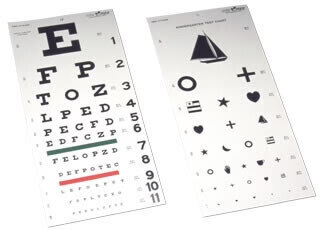
The Snellen Eye Chart is a standardized vision screening tool designed for use at a 20-foot test distance, the baseline from which “20/20” visual acuity is measured. It is professionally printed with crisp, high-contrast black letters and optotypes on a durable white vinyl background. For enhanced utility, the chart features two distinct color bars—often red and green—which are used in ancillary tests, such as the duochrome test, to help refine refractive corrections.
Constructed for longevity and clinical convenience, the chart is double-sided. One side presents the traditional Snellen format, with rows of letters decreasing in size from top to bottom. The reverse side offers a specialized “Kindergarten” test chart, employing simple symbols or shapes like circles, squares, and apples instead of letters. This design accommodates young children or individuals unfamiliar with the alphabet, ensuring accurate vision assessment across age groups.
A practical metal eyelet is incorporated at the top of the Snellen Eye Chart, facilitating easy hanging in examination rooms, schools, or occupational health settings. Its double-sided nature and rugged vinyl material make it a space-efficient and long-lasting resource for routine visual acuity checks, providing a clear, immediate assessment of clarity and sharpness of sight at a distance.
Related products: Pocket Vision Screener.
Q & A
 Snellen Eye Chart
Table of Contents
Frequently Asked Questions
What is a 20/20 vision reading, and how is it determined using the Snellen Eye Chart?
A 20/20 vision reading is the benchmark for standard visual acuity. It means that when you stand 20 feet away from the Snellen Eye Chart—the standardized testing distance—you can clearly identify the letters or symbols on the designated 20/20 line. The chart is specifically designed for this 20-foot distance, and its professionally printed, high-contrast optotypes ensure accuracy. If you can only read letters from a line that a person with normal vision could read from 40 feet away, your vision would be recorded as 20/40. The Snellen Chart provides this immediate, comparative measurement, making it a foundational tool for quantifying the clarity and sharpness of your distance vision in a simple, universal format.
How do you use the chart for individuals who cannot read letters, such as young children?
The Snellen Eye Chart ingeniously addresses this challenge through its double-sided design. For toddlers, preschoolers, or individuals unfamiliar with the alphabet, you simply flip the chart to its reverse side. This side features a specialized “Kindergarten” chart, which uses universally recognizable symbols or shapes—like circles, squares, or apples—instead of letters. The examiner can ask the child to identify or match these shapes, allowing for an accurate assessment of visual acuity without relying on literacy. This inclusive design ensures that vision screening is effective and accessible across all age groups, providing reliable results for non-readers while maintaining the standardized progression of optotype sizes.
What are the red and green color bars on the Snellen Eye chart used for?
These distinct color bars are a sophisticated feature used in a supplementary test called the duochrome or bichrome test. After a standard visual acuity check, this test helps refine the final lens prescription during an eye examination. The patient is asked to compare the clarity of letters or symbols against the red and green backgrounds. Due to the different wavelengths of light, if the letters appear clearer on the red side, it suggests a need for minor adjustment in lens power toward more “minus” (or less “plus”). Conversely, if the green side is clearer, an adjustment in the opposite direction may be needed. The goal is to achieve equal clarity on both colors, indicating a precise and balanced refractive correction.
Reviews
There are no reviews yet