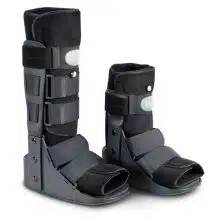
Walking boots can be used in place of plaster or fibreglass casts when the objective is to restrict ankle motion but not necessarily the weight on the foot. One key advantage of a boot over a cast is that it is adjustable and reusable. Another is that you can remove the boot temporarily to wash and clean your foot. Depending on your doctor's advice, you may also be able to remove it to sleep.
Walking braces can have an air bladder to reduce shocks to the foot. When they do, they are known as pneumatic boots. In addition, they can be either tall or short in length. Tall boots can reach to around the knee while short ones can reach approximately halfway between the foot and knee.
Most walking boots are sized, with the appropriate size being based on your shoe size. As with most orthopedic devices, correct sizing is critical. Please pay close attention to the charts accompanying each boot.
Some individuals who have been recommended to wear a walking boot sometimes ask whether one can walk with one. Our response would be that there may be some initial awkwardness due to the difference between the design of the boot and that of a regular shoe. Specifically, most CAM boots use a rocker sole with no flexibility in the toe area. However, after a few days, the patient should become used to the boot. He or she may find it useful to use an aid such as crutches or a cane during that initial period.
You may find additional information about walking braces here.