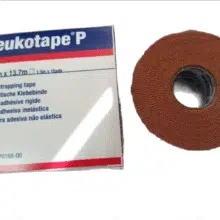
This rigidity provides the tape with additional tensile strength. This in turn equips it to provide more robust support for extra stabilization of joint and muscle structures.
In the overall taxonomy of athletic tapes, medical strapping tapes are in many ways the polar opposite of kinesiology (or K) tapes.
K tape is designed for maximum elasticity and is meant to be comfortable enough to wear for days at a time. It does not restrict joint range of motion. Instead, it is designed to use the natural movement of joints and muscles for its therapeutic effectiveness.
Medical strapping tape, on the other hand, has minimal elasticity and cannot be worn for more than short periods. It is used to limit or control joint and patella movement in order to protect soft tissues or unload painful structures. Like any tape, it must not be applied so tightly that it restricts circulation.
What Is Medical Strapping Tape Used For?
It is typically used to stabilize the larger muscles and joints of the body such as knees and and shoulders. These joints are larger and more powerful than ankles, wrists and the elbow. Many therapists find the extra rigidity of strapping tape better suited to these areas than regular zinc oxide tape.
One of the applications with which strapping tape is strongly associated is McConnell Patellar Taping. This technique was pioneered by Australian physiotherapist Jenny McConnell. It is used as a way to treat a variety of conditions including Knee Osteoarthritis, Patellofemoral Pain Syndrome and Chondromalacia.
When used for shoulder taping, medical strapping tape is typically used to address mild instability of the acromioclavicular joint. The use of strapping tape to address shoulder instability is illustrated in more detail here.
In general, medical strapping tape is used following an injury and before the rehabilitative stage of recovery. It may also be used while playing a sport in order to provide temporarily enhanced joint stabilization and protection.
How Long Can You Leave Medical Strapping Tape On?
Typically, it is used for periods of less than a day to protect the joint while training or other physical activity. At a maximum, it should not be worn for more than 3 -5 days at a time.
This tape typically uses an aggressive adhesive. As a result, the patient should be careful to monitor for any signs that it may be restricting circulation.
If any unusual sensations (such as heat, coldness or numbness) are experienced, the tape should be removed immediately. Medical attention should then be sought.
Patients should also be on the lookout for signs of skin irritation (such as burning, for example)
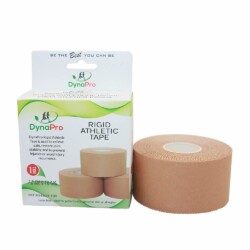
Some medical strapping tapes (such as DynaPro Rigid Athletic tape, pictured above) are latex free and use a hypoallergenic adhesive. As a result, their use presents less risk of skin irritation.
How To Remove Medical Strapping Tape Without Pain
As already mentioned, strapping tape adhesive is extremely powerful. In some cases it is strong enough to tear the skin if adequate care is not taken during its removal.
For elderly patients or anyone with fragile skin, use an underlay tape, keep wear times short, or choose a gentler option.
Some tips that we can provide to reduce pain during removal of strapping tape include the following:
- Use bandage scissors if possible. These have a blunt tip that reduces the risk of cutting the skin;
- Place the scissors over a fleshy area, then slide them under the tape and cut;
- Peel the tape away from the skin slowly and gently, taking care not to peel at right angles to the limb;
- Use a tape remover such as Mueller Tape & Tuffner, if possible.