
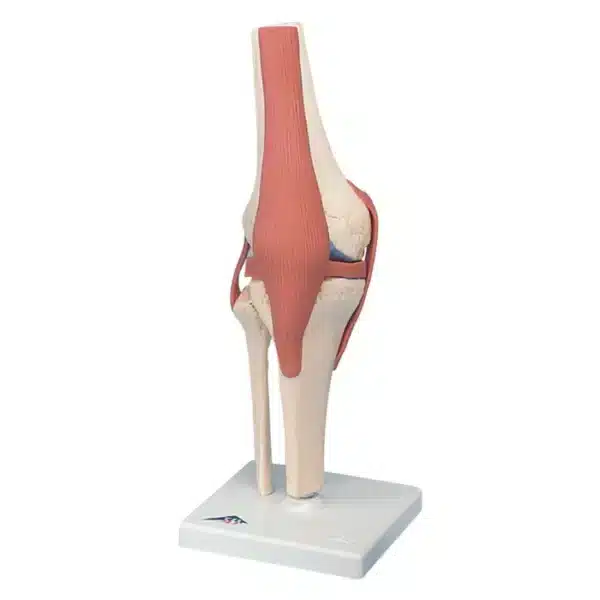
Functional Knee Joint Model
Discover how this functional knee joint model bridges the gap between textbook diagrams and the living human body.
The Functional Knee Joint Model is a detailed, natural-sized anatomical replica designed for precision education. Crafted from high-quality, durable, and latex-free materials, it provides a safe and realistic tactile experience for users in diverse settings, including clinics, hospital consultation rooms, and academic classrooms.
Measuring 13.5 by 7 by 7 inches, this model accurately replicates the intricate bone structure of the knee, featuring the femur, tibia, fibula, and patella. Its true educational power, however, lies in its dynamic demonstration of the joint’s complex ligamentous architecture. Critical stabilizing ligaments—such as the anterior and posterior cruciate ligaments (ACL/PCL) and the medial and lateral collateral ligaments (MCL/LCL)—are faithfully represented, allowing for a clear visualization of their roles in maintaining stability throughout movement.
As a premier teaching aid, the functional knee joint model’s key feature is its capacity for demonstrating all possible physiological movements. Moving pieces enable instructors or healthcare professionals to manually simulate the knee’s primary motions: flexion and extension, as well as limited internal and external rotation. This hands-on functionality is invaluable for explaining biomechanics, common injury mechanisms, and surgical procedures. For patients, it demystifies conditions like ligament tears or osteoarthritis, fostering better understanding of their diagnosis and treatment plan. For students, it transforms abstract anatomical descriptions into a tangible, interactive learning experience.
Ultimately, this functional knee joint model bridges the gap between textbook diagrams and the living human body. It serves as an essential tool for effectively communicating the elegant yet vulnerable mechanics of the knee, making it an indispensable resource for medical education and informed patient care.
Related products: Hand and Wrist Model.
Q & A
 Functional Knee Joint Model
Table of Contents
Frequently Asked Questions
What specific movements and anatomical structures can a functional knee joint model demonstrate?
A functional knee joint model is engineered to replicate the essential biomechanics of the human knee with high anatomical fidelity. It allows for the manual demonstration of primary physiological movements, including full flexion and extension, as well as limited internal and external rotation. This dynamic capability is crucial for illustrating the knee’s complex range of motion.
Anatomically, the model features detailed, natural-sized renditions of the femur, tibia, fibula, and patella. Its core educational value lies in the accurate representation of the major stabilizing ligaments: the anterior and posterior cruciate ligaments (ACL/PCL) and the medial and lateral collateral ligaments (MCL/LCL). These structures are clearly visible and tension appropriately during movement, providing a tangible understanding of their roles in joint stability, common injury mechanisms, and surgical repair principles.
In what educational or professional settings is a functional knee joint model most effectively used?
This model serves as a versatile and indispensable instructional tool across multiple disciplines. In academic settings such as university classrooms and training labs, it provides students of medicine, physiotherapy, sports science, and athletic training with a hands-on, three-dimensional understanding of knee anatomy and kinematics that far surpasses textbook diagrams.
Within clinical environments, including hospital consultation rooms and physiotherapy clinics, it becomes a powerful patient education aid. Healthcare professionals can use it to clearly explain diagnoses like ACL tears or meniscus injuries, demystify surgical procedures, and illustrate rehabilitation protocols. This fosters informed consent and enhances patient understanding of their condition and treatment journey, thereby improving clinical outcomes.
What are the key material and design features that ensure durability and utility of a functional knee joint model?
Crafted for repeated professional use, this functional knee joint model is constructed from high-quality, durable, and latex-free materials, ensuring both longevity and safety for all users. The bones are typically made from a robust synthetic material, while the ligaments are represented with flexible, color-coded bands that withstand repeated manipulation without tearing.
The model’s design prioritizes both anatomical accuracy and functional clarity. Measuring 13.5 by 7 by 7 inches, it offers an optimal balance of detail and handling. The use of distinct colors for different ligaments and bone structures enhances visual learning, while the moving pieces are engineered for smooth, realistic articulation. This combination of premium materials and intentional design guarantees a realistic tactile experience, making it a reliable and effective educational investment for years of use.



Reviews
There are no reviews yet