


Ergonomic Hand Grip, Pair
By: Cando®
These ergonomic hand grips can be used to progressively rehabilitate hand and wrist strength after experiencing events such as a stroke or carpal tunnel.
The CanDo® Ergonomic Hand Grip, Pair helps to rehabilitates grip strength in patients suffering from conditions like carpal tunnel syndrome.
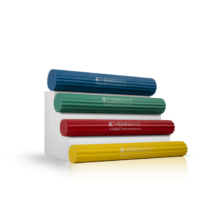
The resistance sequence on these grips covers a wide range of needs, starting from the earliest stages of rehabilitation after experiencing a stroke (yellow) and going all the way to advanced athletic training (black). Each time, you move up a level, the required force doubles.
Q & A

Table of Contents
Frequently Asked Questions
What medical conditions or rehabilitation needs is this hand grip designed to address?
The CanDo® Ergonomic Hand Grip is specifically engineered to rehabilitate grip strength in individuals suffering from carpal tunnel syndrome, a common condition that causes numbness, tingling, and weakness in the hand and fingers. Beyond this, the grip system is widely used in post-stroke rehabilitation, where regaining fine motor control and hand strength is a critical goal.
The grip’s progressive resistance sequence makes it suitable for a broad spectrum of needs. For example, patients in the earliest stages of recovery—such as those relearning basic hand function after a neurological event—can begin with the yellow grip, which offers very low resistance. As strength improves, users can advance through the color-coded levels.
Because the required force doubles with each level, the grips also serve advanced athletic training (up to the black grip). This scalability means the same device can support a stroke patient’s first gentle squeeze and a competitive athlete’s high-intensity conditioning, all while maintaining ergonomic safety for the wrist and hand.
How does the resistance system work, and what does “doubling the force” mean in practice?
The CanDo® Ergonomic Hand Grip features a color-coded resistance sequence that ranges from yellow (easiest) to black (hardest). This design allows both clinicians and users to track progress objectively. The most distinctive feature is that each time you move up one level, the required force doubles.
In practical terms, if the yellow grip requires 5 pounds of force to fully compress, the next level would require 10 pounds, the next 20, and so on. This exponential progression ensures that gains in grip strength are meaningful and measurable, rather than incremental or marginal. For a stroke patient, progressing from yellow to the next level represents a major milestone in neuromuscular recovery.
For athletes or high-level rehab patients, this doubling effect challenges the forearm muscles and flexors in a way that linear resistance cannot. It also helps prevent plateaus, as the jump in difficulty is significant enough to stimulate continued adaptation. Physical therapists often use this feature to set phase-specific goals, ensuring that patients do not move up prematurely, which could risk strain or injury.
Can this hand grip be used for both early-stage recovery and advanced training with the same device?
Yes, the CanDo® Ergonomic Hand Grip is uniquely designed to serve both early-stage rehabilitation and advanced athletic training within a single product system. This is possible because the grips are sold as a pair with multiple resistance levels, and each level is calibrated to a very specific force requirement.
For early-stage recovery—such as following a stroke or carpal tunnel surgery—the yellow grip provides minimal resistance, allowing patients to perform repetitions without overloading weakened muscles or tendons. The ergonomic shape reduces wrist strain, which is critical when joint stability is compromised.
For advanced training, the black grip delivers high resistance that challenges even conditioned athletes. This level is ideal for sports like climbing, tennis, or golf, where grip endurance and crush strength are essential. Because the resistance doubles at each stage, a single pair of grips can accompany a user from initial rehabilitation all the way to peak performance. Clinicians appreciate this scalability, as it eliminates the need to purchase multiple separate devices across different recovery or training phases.



Reviews
There are no reviews yet