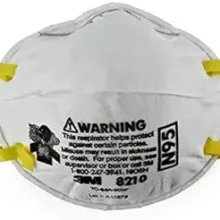
It is important to note that N95 masks are not designed to protect against harmful gases, vapors, fumes, etc. These could potentially be smaller than 0.3 microns.
N95 masks have shown the ability to meet performance standards laid out by the US NIOSH. NIOSH is an acronym that stands for the National Institute for Occupational Safety & Health.
The NIOSH standards include:
- A requirement that an N95 mask should demonstrate the ability to filter out 95% of particles of the size mentioned above.
- Inhalation and exhalation resistance levels of not more than 343 Pa and 245 Pa respectively when air flow speed is 85 L/min;
- Adjustable nasal splints are required and should be capable of providing an airtight seal;
- Although this is not a requirement per se, N95 masks almost universally use a head strap harnessing mechanism. These are believed to provide a closer facial fit than earloops.
The NIOSH N95 standards also include performance standards for exhalation valves, when the N95 mask has one. However, the masks in this section do not have exhalation valves. As a result, these standards do not apply to them.